
 ChatGPT
 Perplexity

You got a mobile app development cost estimate. Here's everything that quote leaves out, and how to build a realistic budget for the full three years.
Highlights:
- App development cost in 2026 ranges from $30K to $300K+ before ongoing costs.
- Post-launch expenses add 30–50% on top of build cost in year one alone.
- Cheap builds compound into expensive rebuilds usually within two years.
Anyone who has been through this knows the moment: the development estimate lands, it's higher than expected, and the instinct is to find ways to cut it. Some do. And some end up rebuilding the whole thing two years later at two or three times the original cost of app development.
The app development cost in a proposal covers the build: the weeks of design, development, and testing to get a working product out the door. It's the visible part. The full picture (what it costs to run and own the software over three years) is what actually determines whether the investment makes sense.
Questions like “How much does it cost to build an app?” have incomplete answers if they stop at the build number. The real cost to develop an app includes everything that comes after launch: maintenance, infrastructure, scaling, and the compounding price of early architectural shortcuts.
At Mind Studios, we've been building custom software with clients since 2013, and most stay with us for three years or more. We see not just what products cost to build, but what they cost to own. If you're sizing a multi-year investment and need a number you can actually defend, talk to our team for a scoped estimate.
What app development costs in 2026: the build number
The mobile app development cost depends first on what you're building.
A basic tool with a handful of functionalities and one platform costs a fraction of a complex platform running across web, iOS, and Android with real-time data, third-party integrations, and a compliance layer.
According to Clutch's 2026 verified project data, the average custom software project costs $132,480 and takes approximately 13 months from kickoff to launch — a useful sanity check, though the average masks wide variation depending on complexity, team location, and technologies chosen.
A 2026 GoodFirms survey puts most projects between $30,000 and $200,000, with nearly 66% of companies falling in the $30,000–$100,000 range for small and medium builds.
The ranges below are 2026 planning figures, not guarantees, but a realistic starting frame.
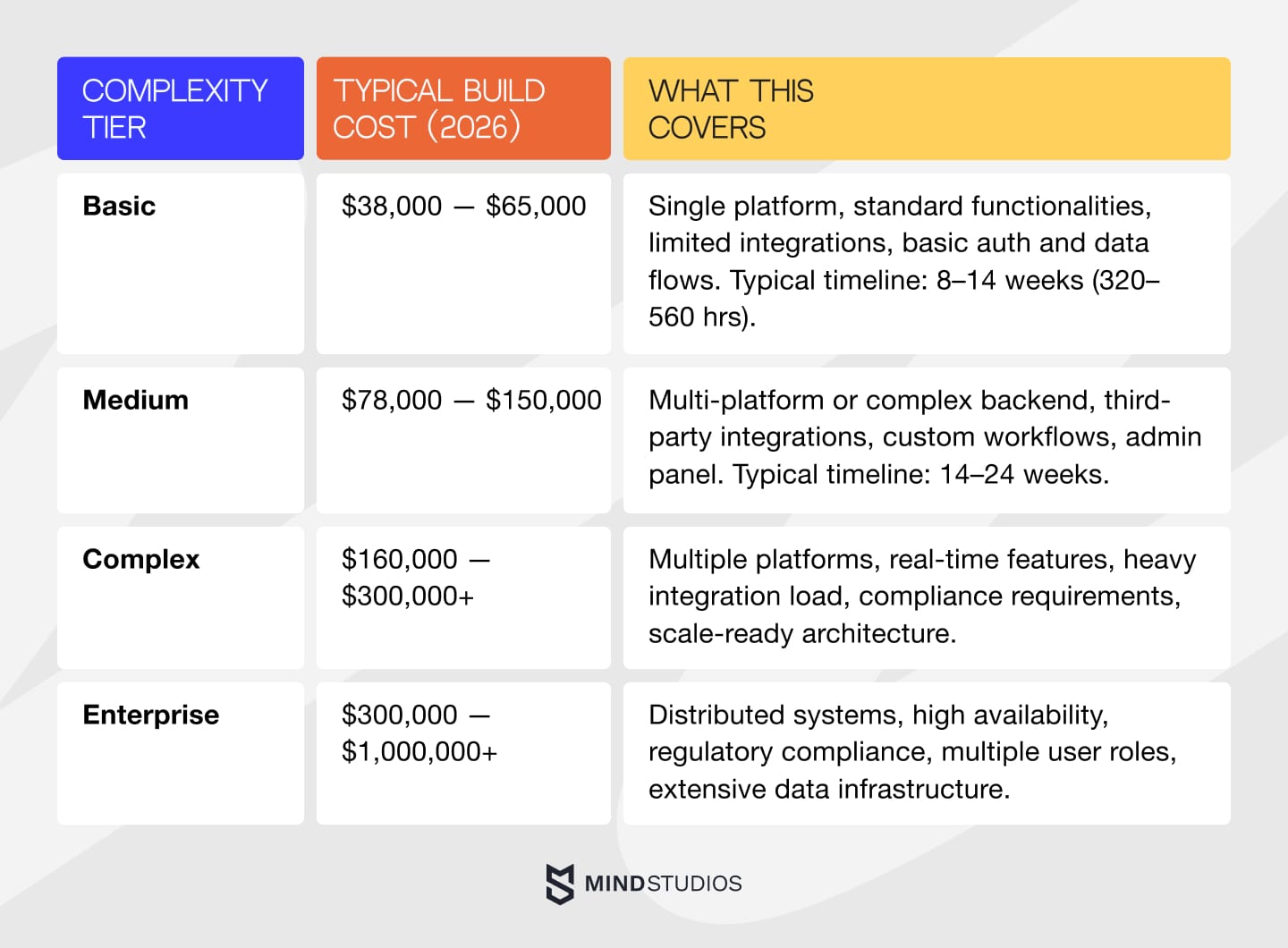
These are app development costs at the software level. For a more detailed cost breakdown by platform, feature, and app type, including the mobile app development cost breakdown for iOS-only vs. both iOS and Android, see our companion piece: How much it costs to make an app in 2026. That article owns the app development cost breakdown at the feature level. This one picks up where it leaves off.
The true cost: what you're actually paying over three years
The build is one line on the ledger. Once the product launches, a different set of costs begins, and this is where most budgets get caught off guard.
McKinsey's State of AI report puts annual maintenance at around 20% of original development cost, covering technical debt, dependency updates, and sustained performance. On a $150,000 build, that's $30,000 per year before infrastructure, third-party licenses, or new features enter the picture.
At the organizational level, Gartner estimates that 55–80% of IT budgets already go toward keeping existing systems running, not building new ones. That's the compounding effect of maintenance costs that weren't planned from the start. The correct question is not what does it cost to build, but what does it cost to own.
Here's what the full three-year picture looks like, depending on the scale and complexity of your product:
| Cost category | Year 1 (post-launch) | Year 2 | Year 3 |
|---|---|---|---|
| Maintenance & bug fixes | 15–25% of build cost | 15–25% of build cost | 10–15% (if architecture is solid) |
| Infrastructure & hosting | $200–$2,000/mo (basic) → $5,000–$30,000/mo (enterprise) | Scales with usage and user growth | Scales with usage and user growth |
| Third-party services & licenses | Varies by integration count | Renewal + new additions | Renewal + new additions |
| Security & compliance | Audit, penetration testing, cert renewal | Ongoing monitoring | Ongoing monitoring |
| New features & scaling | Roadmap-dependent | Typically 30–50% of year-1 build cost | Roadmap-dependent |
Compliance and security alone (such as HIPAA, GDPR, SOC 2 audits) cost $5,000–$50,000 annually, with penetration testing adding $5,000–$20,000 per assessment. These are not exceptional circumstances. They are the normal operating cost of software that is alive and serving real users. A good partner names all of them before the contract is signed.
One place this shows up directly is post-launch support costs and how a partner structures them.
Most post-launch support models charge you for availability whether you need it or not. You pay a monthly retainer, something breaks, and then you pay again to fix it. We built the prepaid model around a different idea: you buy a block of hours, draw down when a case arises, and always know what's left. No idle retainer, no surprise invoices. Post-launch stops being a cost you absorb and starts being a cost you control.
— Anton Baryshevskyi, CBDO at Mind Studios
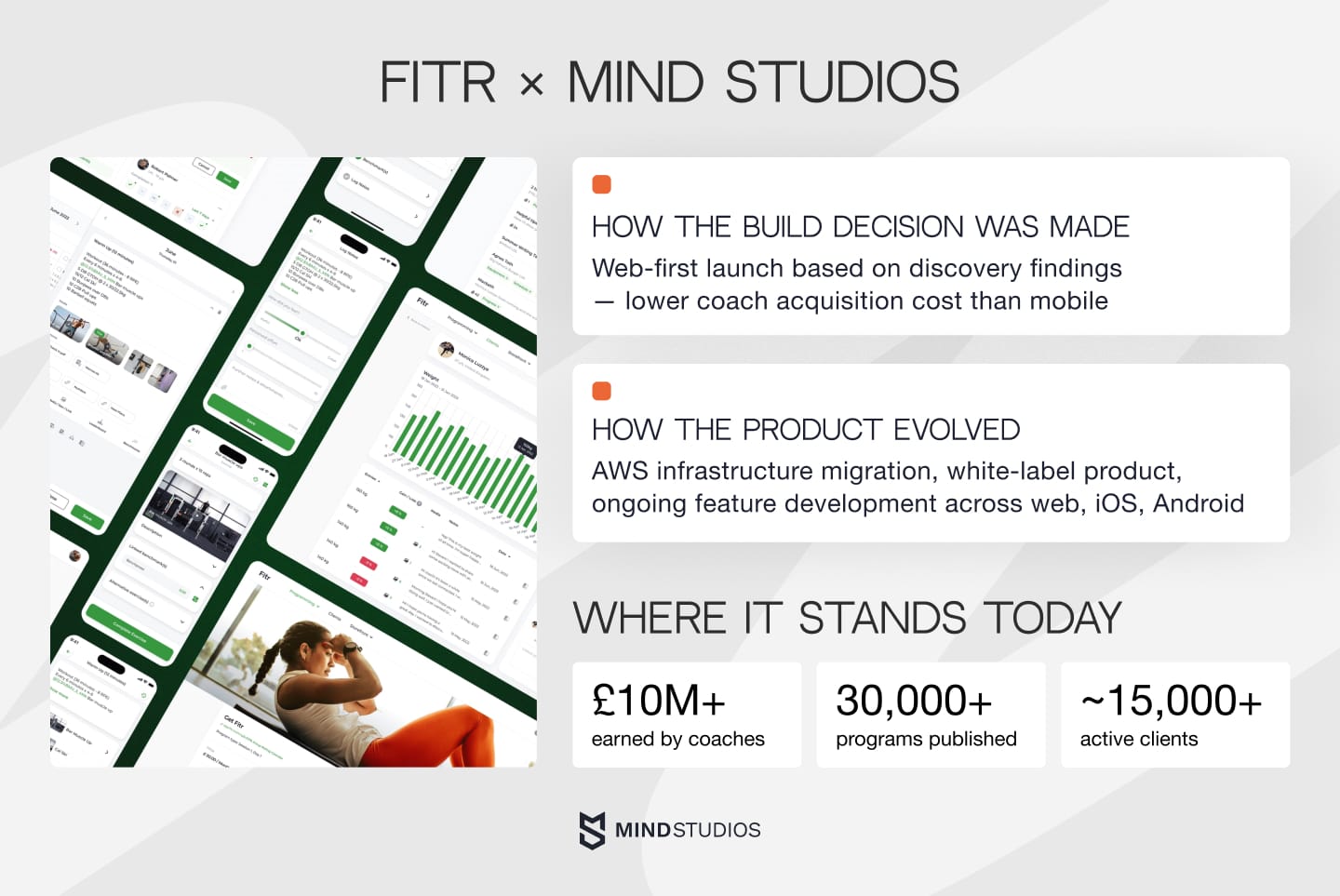
Our FITR engagement has been running since 2017. Here's what seven years of planned investment looks like in practice:
Not sure what your three-year number actually looks like? Get a cost breakdown.
What drives your mobile app development costs
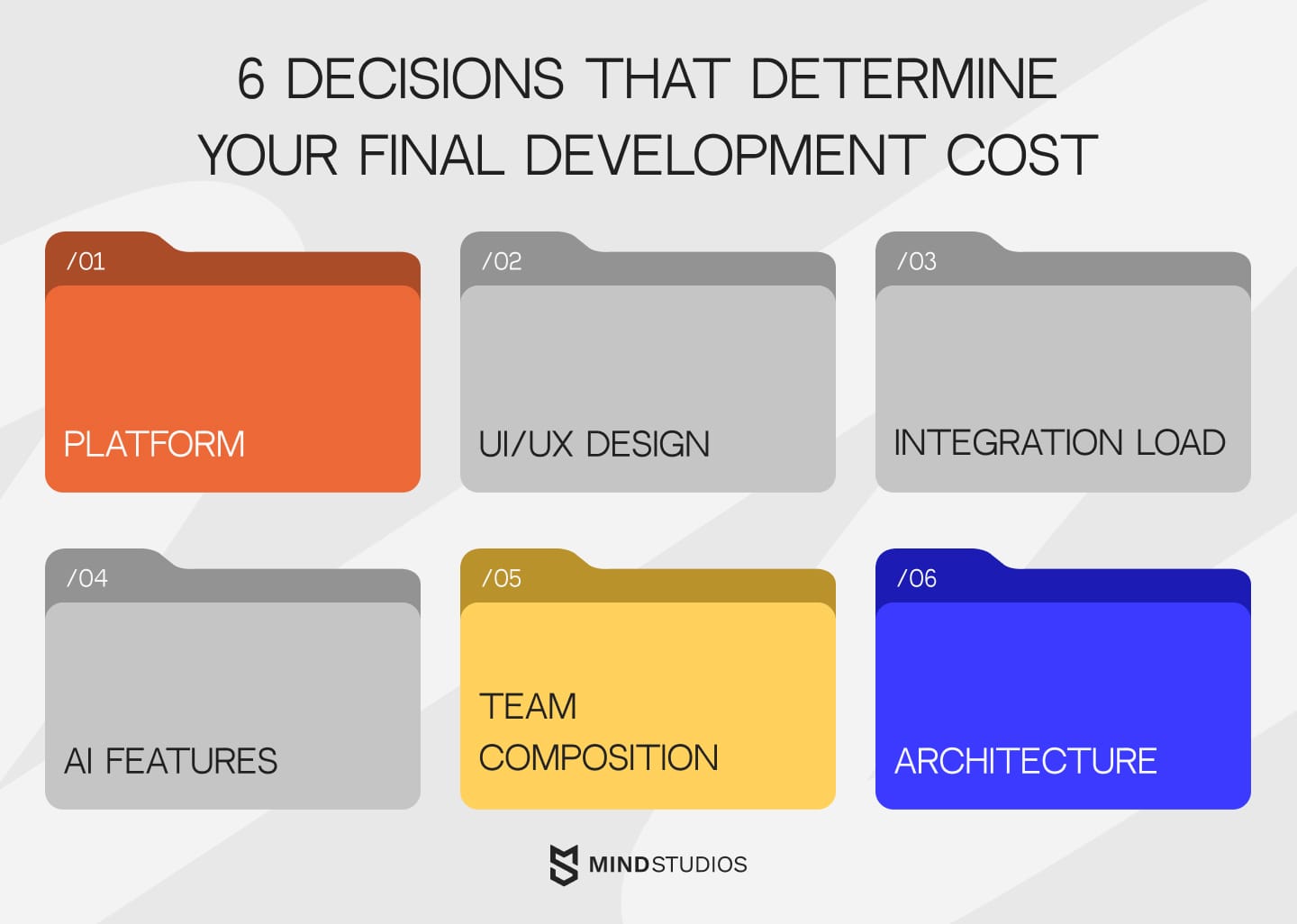
The cost of mobile app development isn't set by a price list but the product of a set of decisions, some made early and some made late. Understanding which factors move the number most is how you budget intelligently rather than just cutting scope.
Platform: the first decision that determines everything
Each platform you support is its own build.
Web, iOS, and Android do not share codebases in native development; thus, an Android app cannot be converted into an iOS version. Cross-platform frameworks (React Native, Flutter) reduce some overhead but introduce tradeoffs in performance and platform-specific behavior.
If your users are concentrated on one platform, start there and expand based on real usage data. This single decision can shift the cost to build a mobile app by 40–60%.
UI/UX design: the cost of getting it wrong later
Design is not cosmetic. Poor UI/UX raises a mobile application development cost in ways that are easy to miss: user drop-off, mounting support load, and costly redesigns post-launch.
A product that users find confusing gets abandoned, and rebuilding the experience after launch costs more than doing it properly at the design stage. Some of our strongest delivery outcomes have come from projects where the design phase was given proper time and budget rather than compressed to hit a lower estimate.
Integration load: the most underestimated line item
Every third-party connection (such as payments, geolocation, identity verification, CRM, analytics, or compliance services) adds to the cost to develop an app.
Common integrations with well-documented APIs (Stripe, Google Maps, Firebase) are relatively straightforward. Older systems, proprietary data sources, or custom API development add materially to both build time and ongoing maintenance.
Mind Studios’ insight: Our developers have found that projects requiring five or more third-party integrations consistently see 20–35% higher build cost than initially estimated.
AI features: the cost driver that cuts both ways
AI is a genuine 2026 cost variable that cuts in two directions.
McKinsey's research on AI in software development finds that AI coding tools reduce time spent on routine tasks by an average of 46% — a real compression on build cost, though one that comes with caveats around code review time and quality oversight. That's the upside.
The other side: building AI features into the product itself (recommendations, natural language interfaces, automated workflows, predictive analytics) adds to both build and run cost in ways that rarely appear in an initial quote. Model costs, API fees, data infrastructure, and ongoing tuning are recurring line items.
Gartner forecasts global AI spending will reach $2.5 trillion in 2026, which is a signal of how fast these costs are scaling across the industry.
Budget for both sides before the quote arrives.
Team composition: what you're actually paying for
The hourly rates quoted by different vendors vary widely, and rate is not the same thing as cost.
- A more experienced team of developers moves faster, makes fewer architectural mistakes, and requires less rework.
- A senior architect who spots a structural problem in week two saves you from a full rebuild in year two.
- The cost to make an app with an underqualified team is always higher than the invoice suggests, because the invoice doesn't include the rework.
Why the cheapest build is usually the most expensive product
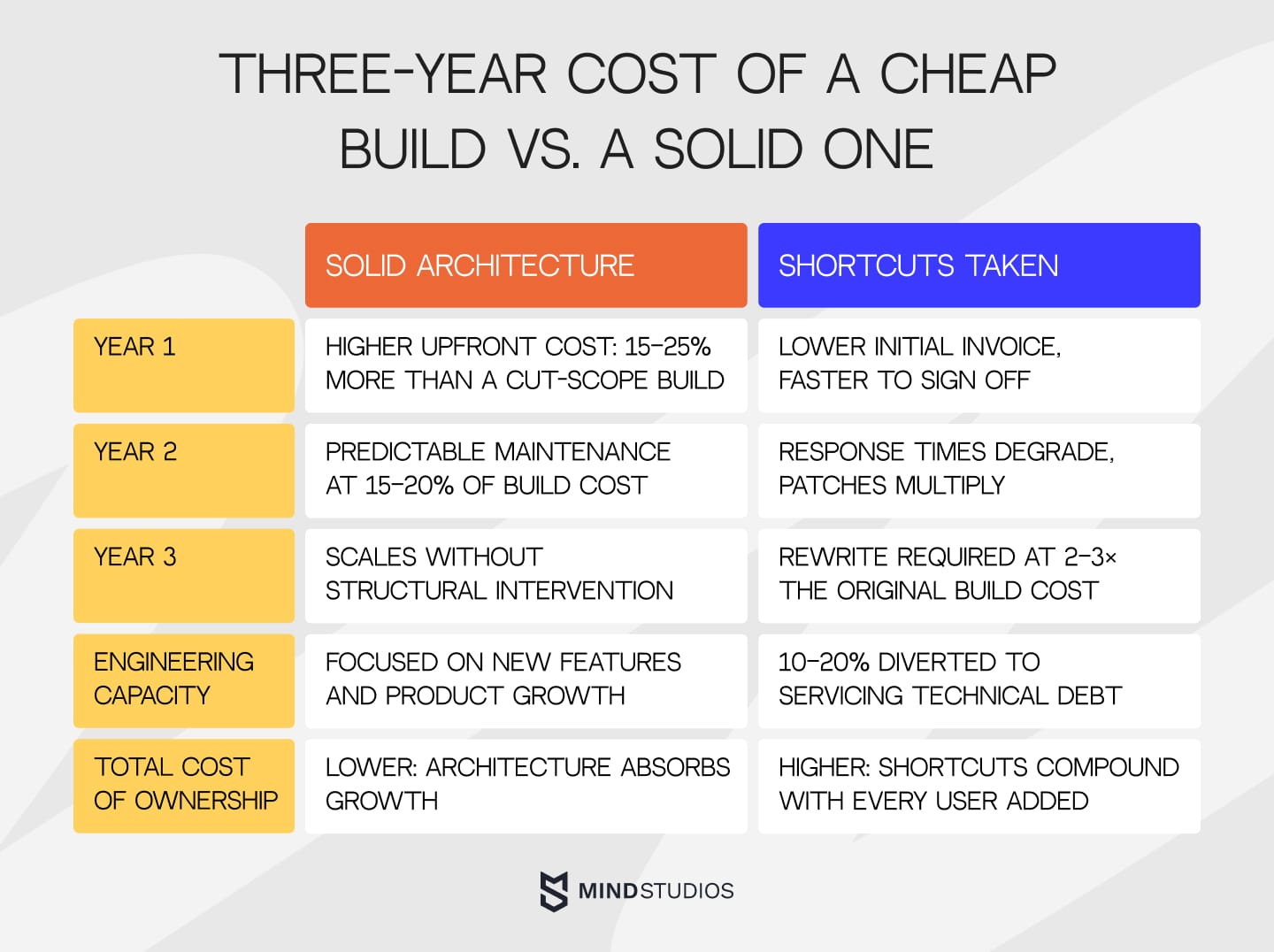
This is the counterintuitive truth that anyone managing a software budget learns at least once. The app creation cost is not what you pay at launch but what you pay over the life of the product.
How technical debt compounds
Architectural shortcuts taken to reduce the initial estimate create technical debt that compounds.
Monolithic structures that can't be decoupled. Minimal testing. Tightly coupled solutions that create vendor lock-in. The platform works fine at 500 users. At 5,000, response times degrade. At 50,000, you're looking at a rewrite, at the worst possible moment, when the business is growing and every engineering hour should be going toward new functionalities, not repairs.
The numbers bear this out. According to McKinsey's survey of 50 CIOs, 10–20% of the technology budget dedicated to new products is diverted to resolving technical debt, and CIOs estimate that tech debt amounts to 20–40% of the value of their entire technology estate.
Separately, McKinsey and the University of Oxford, studying over 5,400 IT projects, found that large software projects run 45% over budget on average and deliver 56% less value than predicted.
The root cause in both cases is the same: decisions made early to save money that compound into far larger costs later.
What the right architecture actually buys you
Modular, API-first architecture delivers three concrete things over a three-year horizon:
- Maintenance costs stay predictable
- Engineering capacity stays on the roadmap
- Scaling becomes an infrastructure decision rather than a rebuild
The outcome is a product that grows with the business instead of against it. When architectural shortcuts accumulate into a system that can no longer scale, the path forward is usually a legacy modernization project, which costs more than building it right the first time would have. This is the case we make to every client who asks us to cut the architecture investment. We explain the trade. The decision is theirs.
Concerned your current architecture is already accumulating debt? Let's talk.
Making the budget case: framing cost as investment
The investment case for custom software rarely sells itself on cost alone — it sells on return. The frame that works: what does this software save, earn, or replace over three years? And what is the revenue model that makes the investment defensible?
A build number alone rarely gets board approval. What gets approved is a return. The frame that works is straightforward: what does this software replace, what does it generate, and what does it cost to run over three years? When you can answer those three questions with real numbers, the conversation shifts from whether you can afford to build it to what it costs to wait. That's a different conversation, and a more productive one.
— Dmytro Dobrytskyi, CEO at Mind Studios
A few questions that sharpen the case:
- What manual process does this replace? If the product automates work currently done by people, what does that labor cost annually? Three years of that number versus the build cost is a straightforward comparison, and one that lands well with finance teams.
- What does acquiring a customer cost without this product? FITR's discovery phase revealed that a web platform for coaches had a dramatically lower customer acquisition cost than mobile — that single insight shaped the entire build sequence and affected the multi-year economics, not just the initial estimate.
- What's the cost of not building? Delayed market entry, continued manual operations, a competitor who ships first — these have real costs that belong in the same conversation as the development budget.
- What does the revenue model look like at scale? Subscription, transaction, licensing — the right architecture and technologies for each model differ. Building for the wrong model creates expensive rework when the business matures.
A framework, not a formula. Every project is different, and we don't manufacture ROI projections. What we do is help technical leaders think through these numbers honestly during the estimation process, so the investment decision is made on complete information, not just a build quote.
How Mind Studios estimates your development cost
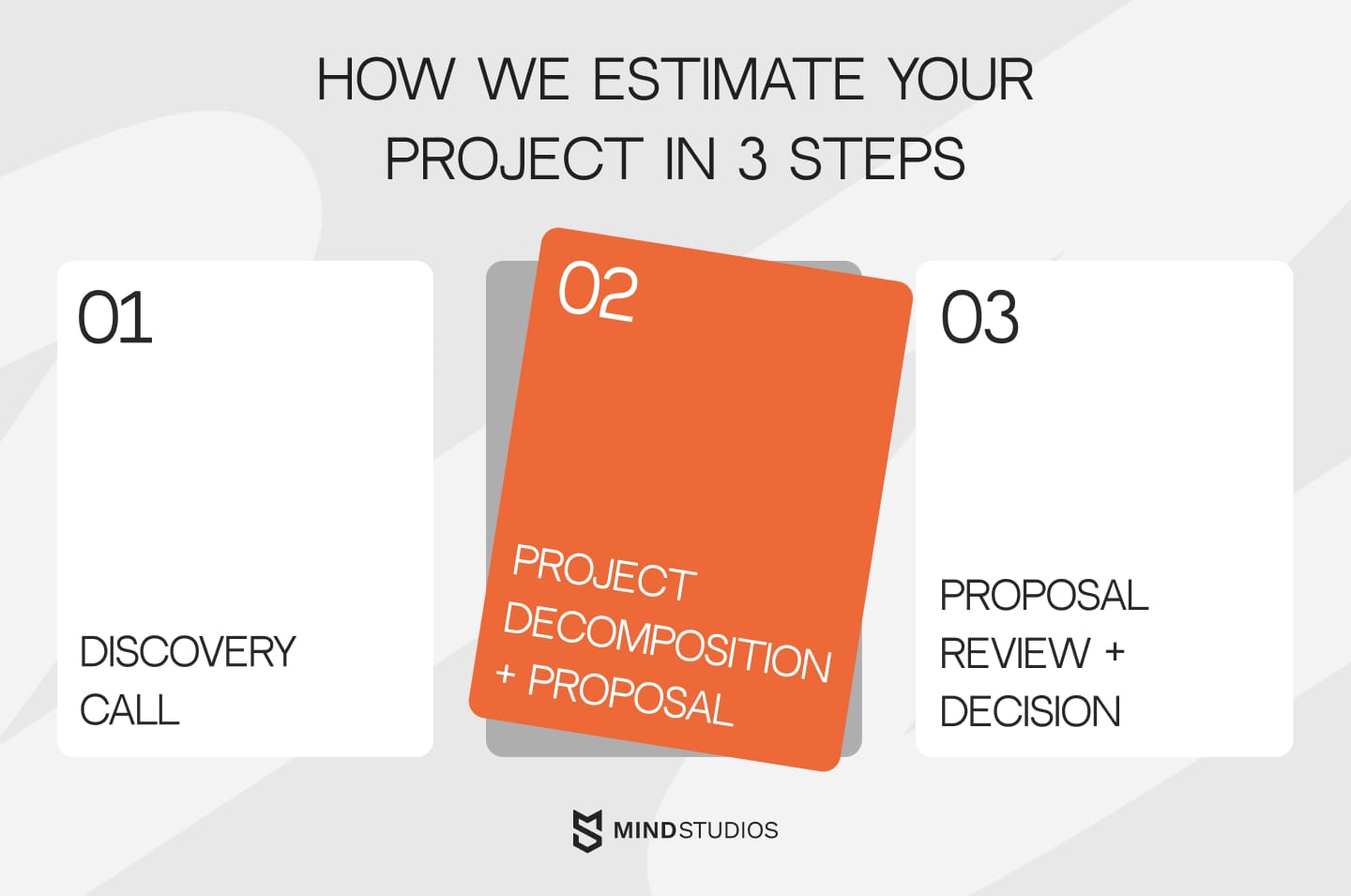
We've been refining our estimation process since 2013, and it runs in three stages designed to give the client the most accurate number possible before committing to the full build.
Stage 1: Discovery call
After you fill in the contact form, we set up a call, not to pitch, but to understand.
We ask about requirements, platforms, features, integrations, compliance needs, and the business context. The more specific the brief, the tighter the estimate.
How much does it cost to develop an app for your specific use case, on your target platforms, with your integration requirements? That question has a far more accurate answer after a proper discovery conversation than before one, and a far narrower price range attached to it.
Stage 2: Project decomposition
We break the project into discrete work units (design, development by module, integration, testing, and delivery) and estimate each one in hours.
The output is a proposal with a price range and a detailed description of the discovery phase: what we'll do, what decisions it will surface, and what we expect to produce.
The discovery phase often changes the estimated total, sometimes meaningfully, because it resolves the unknowns that make initial ranges wide.
Stage 3: Proposal review
We walk through the proposal together. If the estimate is outside your budget, we don't shrug but re-examine the scope to find what can be phased, simplified, or sequenced differently.
One concrete option: a discovery-phase-only engagement. You commission the discovery, get a detailed technical specification and business model, and use that to approach investors or re-scope the full build with complete information.
We also maintain a network of investors and can help prepare pitch materials for clients in that position.
How to spend wisely: Prioritize spend, don't just cut it
Unclear scope is the single largest driver of budget overruns, and it's almost never because development is inherently unpredictable. It's because the scope wasn't properly defined at the start. Scope discipline is the most reliable cost control available.
Provide maximum detail at the presale stage
The more precisely you can describe what you're building (user flows, platform targets, integration requirements, monetization model, and known constraints), the narrower your estimate range.
A vague brief produces a wide range with a high upper bound. A specific brief produces a tight range you can plan against. Most cost surprises in custom software development trace back to a brief that was too thin at the start.
The engagement model you choose also affects the total number. Dedicated team, fixed price, and T&M each carry different cost structures and risk profiles depending on how well-defined the scope is at the start.
Prioritize the initial scope ruthlessly
Build what solves the core problem. Not what might be nice to have, not the full roadmap. The question is, "What is the minimum product that generates a real signal from real users?”
Clickable prototypes in Figma can validate interaction assumptions before a line of code is written — an underused option that costs a fraction of discovering the same problem post-launch. The hours saved by validating early typically exceed the time the prototype takes to build.
If the question is whether to build at all versus buying an existing tool, that decision belongs earlier than most teams make it. AI app builders and no-code platforms are worth evaluating before scoping a custom build.
Don't skip discovery or QA — they're the cheapest insurance available
These are the two most reliably expensive things to cut.
- Skipping discovery means building on unvalidated assumptions; the rework when those assumptions prove wrong costs more than the discovery would have.
- Skipping QA means shipping defects that become a support burden, user trust problems, and costly patches.
Both are false economies with well-documented downstream costs. In our experience, the products that generate the most post-launch support tickets are almost always the ones where QA was compressed to hit a deadline or a budget ceiling.
The same logic applies to the build-vs-outsource decision. The cost comparison between in-house and outsourced development shifts significantly once ongoing maintenance, hiring, and retention are factored in, not just the initial build.
Conclusion
The cost to create an app doesn't end at launch — it begins there. The teams that manage this well don't negotiate the build quote down and hope for the best. They scope precisely, invest in the architecture, and pick a partner they'll still be working with in year three.
If you want an estimate built on that logic rather than the lowest number we can put on paper, get in touch with Mind Studios. We can scope the full build or start with a discovery phase if you need a defensible number before committing.