
 ChatGPT
 Perplexity

Most budget conversations stop at the build quote. This one doesn't. Here's the full picture: build cost, total cost of ownership, and where budget decisions compound, including the true costs of software development most teams never see coming.
Highlights:
- Software development costs range from $30,000 to $500,000+, depending on complexity in 2026.
- Maintenance and infrastructure add 15–20% of your build cost every year after launch.
- Architectural shortcuts compound — the cheapest build is rarely the cheapest product long-term.
When someone asks how much software development costs, they usually mean, "What will the build quote say?" That is the wrong question, or at least an incomplete one.
The build is what you pay once. What you pay to run, maintain, secure, and scale the product is what software actually costs. The costs of software development extend well beyond that first invoice, and teams that plan only for the build end up either underfunding operations or rebuilding sooner than expected.
This article covers both: realistic 2026 build ranges by complexity, and the full picture of what owning software costs over time.
Mind Studios has been building and maintaining complex products since 2013 — our one of the longest-running partnerships, FITR, has been in active development since 2018. The cost of software is not a number; it is a trajectory.
For a realistic estimate on your specific project, contact us, and we will scope it properly.
What software costs to build in 2026
The build quote is the number everyone asks for first.
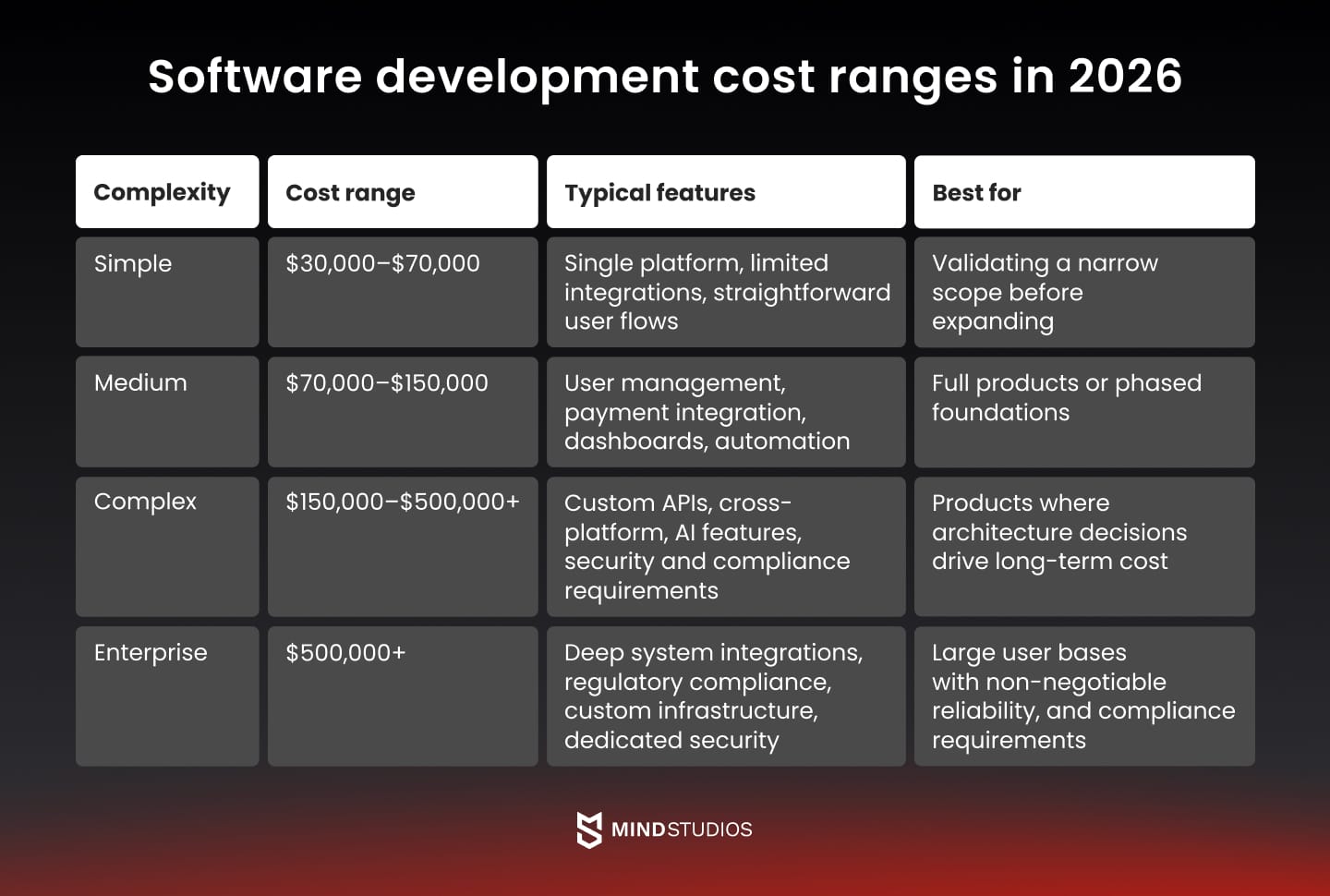
Here are realistic planning ranges for 2026, organized by complexity, not by app type, since the same complexity tier applies whether you are building a SaaS product, an internal tool, or a client-facing platform.
Software development prices vary significantly across these tiers; the software development cost breakdown below gives you a working framework.
These are software-level ranges. For a mobile-app-specific breakdown, see How Much It Costs to Make an App.
Simple software: $30,000 to $70,000
Limited feature set, straightforward user flows, minimal third-party integrations. Typically, a single platform. Works well as a first production version when the scope is deliberately narrow, and the goal is to validate before expanding.
Medium complexity: $70,000 to $150,000
Core features plus several advanced ones: user management, payment integration, dashboards, and some automation. Can operate as a full product or serve as the foundation for a more complex system built in phases.
Complex software: $150,000 to $500,000+
Multiple integrations, custom APIs, cross-platform delivery, significant security and compliance requirements, high concurrency, or AI features. This is the tier where architectural decisions made at the start have the largest long-term cost consequences.
Enterprise: $500,000 and above
Large user bases, deep system integrations, regulatory compliance, custom infrastructure, dedicated security layers. Timeline and cost are scoped per project; averages are not meaningful at this level.
Note: These are planning ranges, not fixed quotes. The software development price for your specific project depends on the variables that move the number ( team composition, integration load, discovery depth, and timeline) covered in the cost factors section below.
These ranges are starting points. The variables that move your number (such as integration load, platform scope, team composition, and architecture requirements) are specific to your project. Get a scoped estimate from Mind Studios, and we will give you a realistic range, not a ballpark.
What you pay after launch: the real cost of owning software
The build quote covers one line item. What follows is where most budgets get surprised.
Industry benchmarks put annual maintenance at 15–20% of the original build cost. On a $150,000 product, that is $22,500 to $30,000 per year before you have added a single feature or scaled your user base.
Across three years, the cumulative post-launch spend on a mid-complexity product routinely matches or exceeds what you paid to build it. This is not a worst-case scenario but the standard trajectory for software that is actually being used and maintained properly.
| Cost item | What it covers | Typical monthly range |
|---|---|---|
| Maintenance & bug fixes | Dependency updates, OS/browser compatibility, integration stability | Included in annual budget (15–20% of build cost per year) |
| Infrastructure & hosting | Servers, databases, CDN, storage, monitoring | $200–$500 (simple) to $5,000–$30,000 (complex, high load) |
| Third-party services & licences | Payments, analytics, messaging, identity verification, mapping tools | $1,000–$5,000+ depending on service stack |
| Security & compliance | Audits, penetration testing, compliance reviews, ongoing patching | Varies; non-negotiable for payments, health data, personal information |
| Scaling & new features | Architectural work for growth, ongoing feature development | Project-based; plan as a recurring line item, not a future surprise |
Maintenance and bug fixes
Software does not stay functional on its own. Dependencies update, browsers change, OS versions shift, and integrations break. Routine maintenance keeps the product stable and secure. Skipping it does not eliminate the cost — it defers it, with interest.
Infrastructure and hosting
A simple product might run on $200–$500 per month in infrastructure costs. A complex platform under real load can reach $5,000–$30,000 per month. The number scales with users, data volume, and reliability requirements. Infrastructure costs are often underestimated at the build stage because they are invisible until the product is live and growing.
Third-party services and licences
Payments, analytics, messaging, identity verification, mapping, monitoring tools — most production software depends on a stack of external services. Each has a cost that scales with usage. A product running on five or six third-party services can accumulate $1,000–$5,000 per month in license and usage fees before accounting for anything custom.
Security and compliance
Security is not a one-time implementation. Audits, penetration testing, compliance reviews, and ongoing patching are recurring costs. For products handling payments, health data, or personal information, this line item is non-negotiable and often underbudgeted at the build stage.
Scaling and new features
A product that works for 500 users may need architectural work to support 50,000. Feature development continues as long as the product is live. Planning for this as a recurring cost rather than a future surprise is the difference between a product that scales cleanly and one that accumulates technical debt until a rebuild becomes unavoidable.
Mind Studios’ insight: Most vendors bill a retainer whether or not anything breaks. At Mind Studios, clients purchase a package of support hours and draw it down only when a case arises. Predictable cost, no idle billing, no surprises.
8 years with FITR: what sustained investment looks like
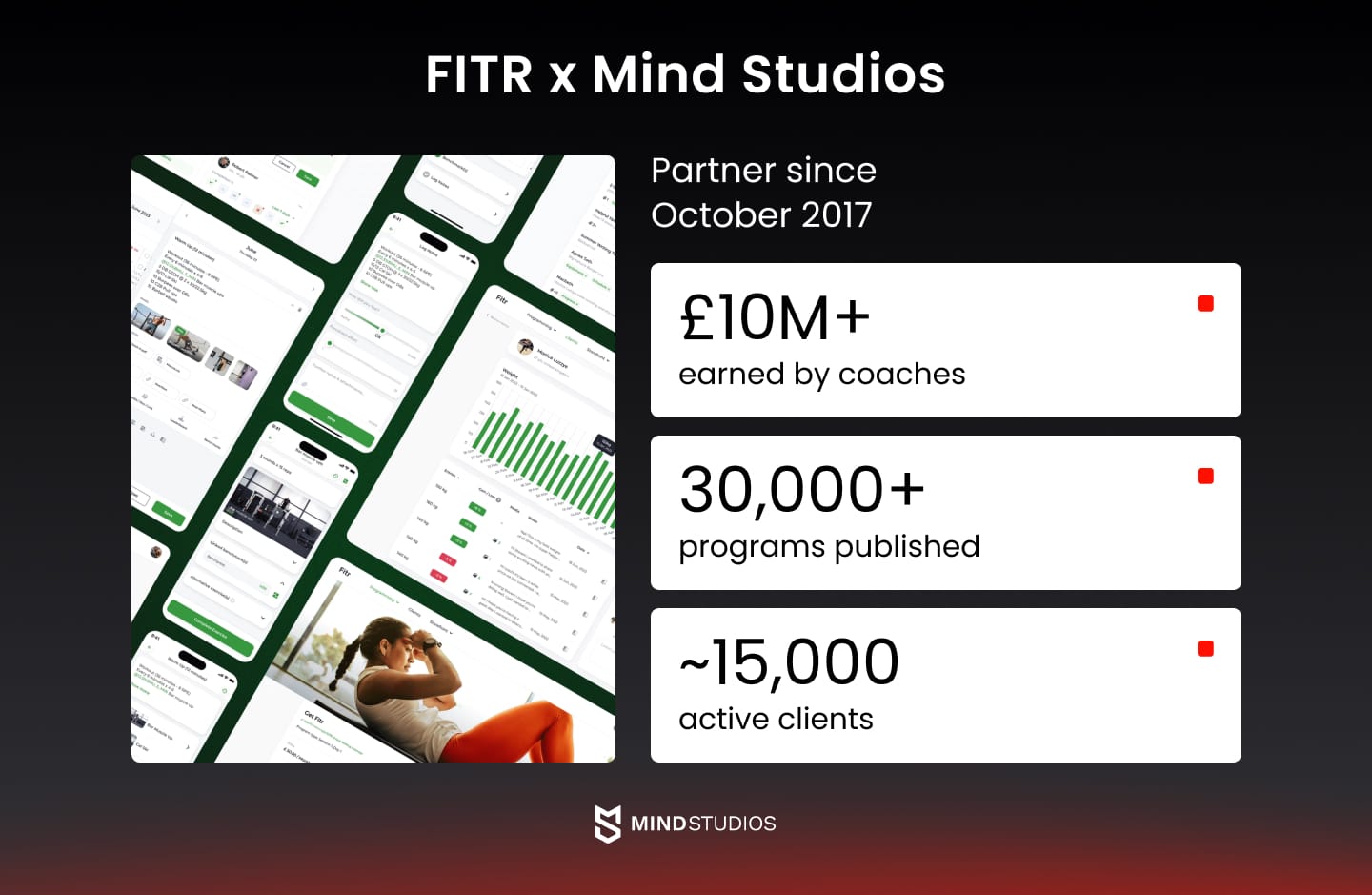
FITR is a coaching platform for personal trainers: program management, client communications, and payments, all in one place. Mind Studios has been the development partner since October 2017, across web, iOS, and Android.
The work did not end at launch. It has continued through an AWS infrastructure migration (85.5% improvement in average response time, full elimination of user-visible errors under load), a white-label product tier, Zapier integration, and ongoing feature development guided by live usage data.
The outcomes (£10M+ earned by coaches on the platform, 30,000+ programs published, ~15,000 active clients) came from eight years of continued investment, not the initial build. That is what well-managed TCO looks like: not a surprise, not a rebuild, but a compounding return on sustained commitment.
What drives your software development cost
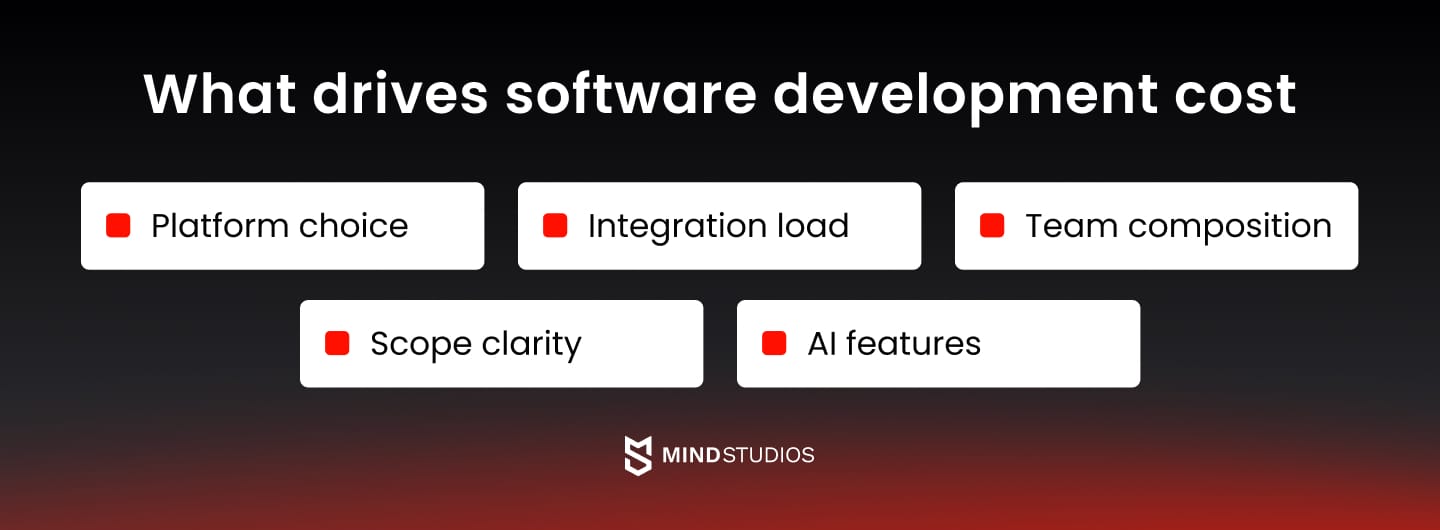
Not all cost variables are equal. Some are decisions you control from the start; others surface during development and carry a higher price tag the later they appear.
Here are the factors that move the number the most.
Platform
Each platform you support adds to the build and maintenance cost. A web product costs less to build and maintain than a web-plus-iOS-plus-Android product.
The right answer depends on where your users actually are, not on what feels most complete. If the budget is constrained, start where your audience is densest and expand later. Building for the wrong platform early is one of the more avoidable cost mistakes.
UI/UX design
Design complexity affects both build cost and long-term retention. A poorly designed product costs money twice: once to build, and again when users abandon it, and you commission a redesign. The investment in solid UX at the start is cheaper than recovering from a bad first version.
Integrations
Every third-party system you connect to (payments, identity verification, mapping, analytics, CRMs, or ERPs) adds to the build cost and to the ongoing maintenance surface.
Widely adopted services like Stripe or Auth0 are relatively straightforward. Legacy systems, custom enterprise APIs, or anything with poor documentation cost significantly more. The integration load is one of the most reliably underestimated cost drivers at the scoping stage.
AI features
AI integration adds complexity to the cost picture in 2026.
- On the build side, AI-assisted development can compress some coding time — estimates from the industry put the reduction at roughly 20–40% on certain task types.
- On the product side, adding AI features (recommendation engines, generative interfaces, or intelligent automation) adds meaningful cost to both build and run.
Inference costs, model hosting, and ongoing tuning are recurring line items that need to be in the TCO plan from the start, not retrofitted after launch.
Team composition
What you are paying for in a development team is judgment and seniority, not geography. A senior architect who catches a structural problem in week two costs far less than a junior team that ships a scalable-looking product that needs a re-engineer in year two.
Team composition (the ratio of senior to mid-level engineers, the presence of a dedicated BA, whether architecture review is built into the process) affects total cost more than hourly rates do.
Scope clarity
Unclear scope is the single largest cost multiplier in software development and the most common challenge clients bring to the first scoping conversation.
Projects with poorly defined requirements consistently run over budget — some analyses put the average overrun above 80% on projects where the scope was not locked before development began.
Every assumption that gets made during development rather than resolved during discovery adds rework cost later. This is the variable most within your control, and the one most often underinvested.
Every cost driver lands differently depending on your product. Talk to Mind Studios — we will tell you which variables matter most for your specific scope and where the budget pressure points are likely to be.
Why the cheapest build usually costs the most
There is a pattern that shows up reliably in software projects: the team that quoted the lowest delivers a product that needs to be rebuilt in two years. By the time the rebuild is scoped and funded, the total spend exceeds what a well-architected build would have cost at the start.
The mechanism is technical debt. Architectural shortcuts that make a build faster and cheaper upfront (skipping proper modularization, hardcoding integrations, deferring security layers, building for current load rather than projected load) accumulate into a system that becomes progressively harder and more expensive to change.
Features that should take two weeks take six. Integrations that should be straightforward require workarounds. The codebase that looked functional at launch becomes the thing your next development team refuses to touch without a full audit.
For a CTO, this is an architecture argument: modular, API-first systems carry lower long-term cost because they are built to change. For a budget owner, it is a spending argument: the three-year cost of a cheap build almost always exceeds the three-year cost of a well-structured one.
A few places where shortcuts compound most aggressively:
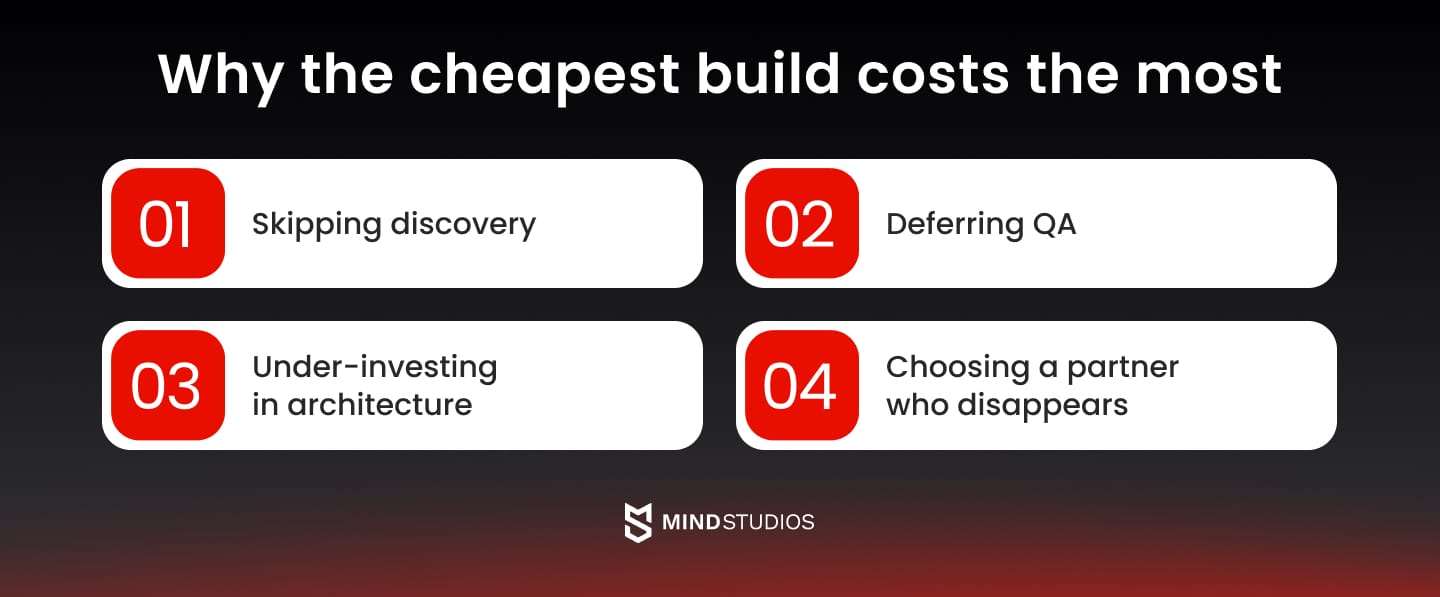
- Skipping discovery. Building without a proper discovery phase means requirements get resolved during development, where changes are expensive, rather than before it, where they are cheap. Skipping discovery to save $15,000 upfront routinely adds $50,000+ in rework.
- Deferring QA. Quality assurance built into the development process costs less than bug-fixing after launch. Post-launch defects also carry a second cost: user trust, once lost, is harder to recover than a codebase.
- Under-investing in architecture. A system built without scale in mind works fine at 500 users and fails at 50,000. Re-engineering for scale after the fact — which is what legacy modernization usually is — costs more than building for scale from the start. For context on what that re-engineering looks like, see our Legacy System Modernization article.
- Choosing a partner who disappears after launch. The post-launch phase is where most of the cost decisions get made. A vendor who hands off the codebase and walks away leaves you managing those decisions without the context to make them well. The continuity of the development relationship is itself a cost variable.
The right frame is not "How do I build this cheaply?", but "How do I build this so the three-year cost is defensible?" Those are different briefs, and they produce different outcomes.
Making the budget case for software development
At some point, the cost conversation moves from "What will this cost?" to "How do I justify this investment?"
Whether the audience is a board, a CFO, or an investment committee, the build number alone rarely closes the argument. What closes it is the return.
The question to answer: What does this software save, earn, or replace over three years? Not invented multipliers — real operational logic.
A few frames that translate cost into investment:
- Cost of the alternative. What does the current situation cost: in manual labor, lost revenue, process inefficiency, or competitive disadvantage? If the answer is $200,000 per year in operational overhead, a $300,000 build with $50,000 annual maintenance pays back in under two years. The build number looks different next to that calculation than it does in isolation.
- Cost of delay. Every quarter spent without the product is a quarter of market position, user acquisition, and operational efficiency foregone. For products in competitive markets, delay has a real cost that belongs in the investment case.
- Cost of the wrong build. If the alternative to a well-scoped project is a cheaper build that needs re-engineering in 18 months, the relevant comparison is not cheap build vs. good build — it is cheap build plus rebuild vs. good build once. That comparison almost always favors the latter.
That shifts the conversation from a cost approval to an investment decision. Those are evaluated differently, and the software development investment usually looks stronger under the second lens.
One practical note: Discovery phase outputs — a detailed business model, finalized product vision, and thorough technical scope — are often enough to secure internal budget approval or external funding before committing to a full build. If the full budget is not yet in place, starting with discovery is a lower-commitment way to produce a defensible number and the documentation needed to get sign-off.
How Mind Studios estimates software development cost
Most estimates are guesses dressed up as numbers. The variables that actually determine cost, such as scope clarity, integration complexity, architecture requirements, and team composition, cannot be read from a feature list. Getting to a defensible range requires a process.
Ours has three stages.
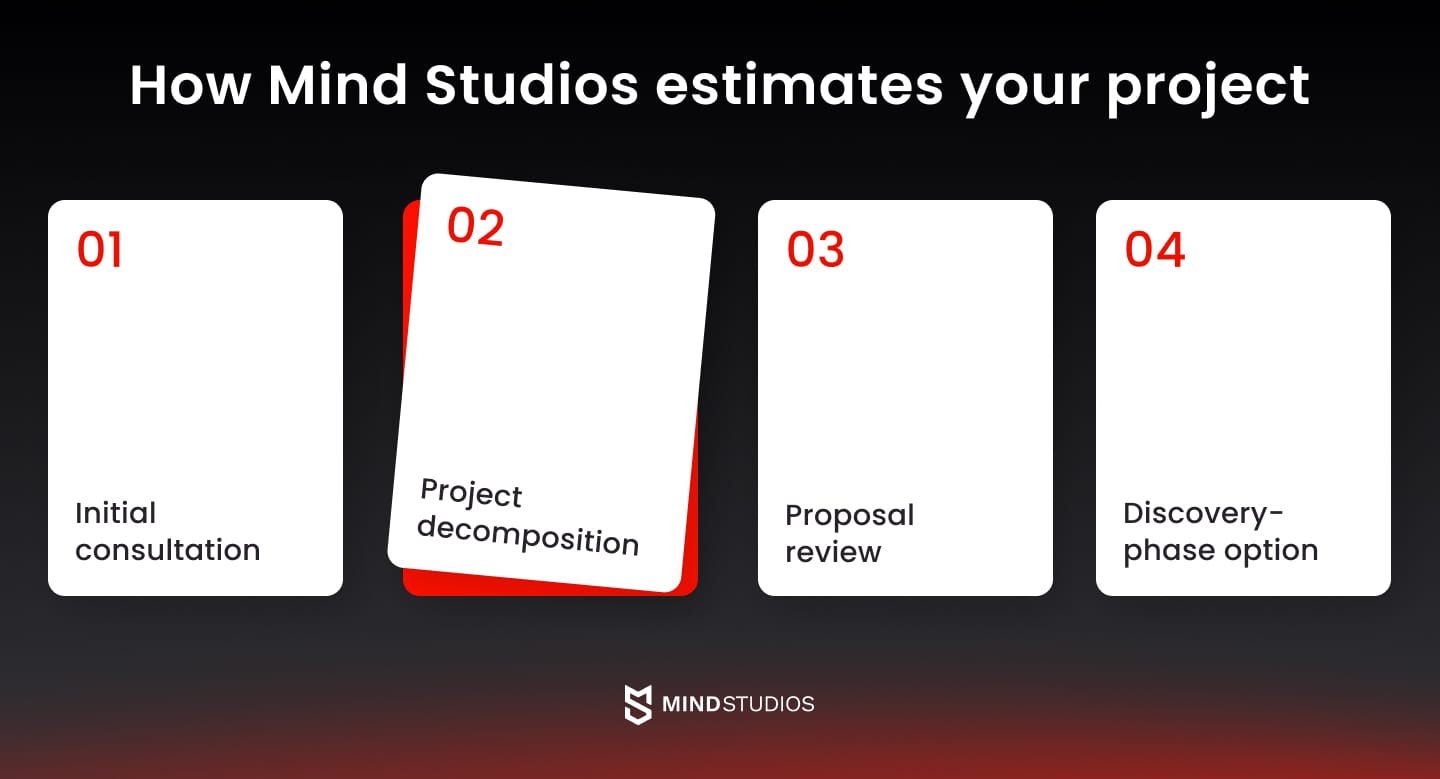
1. Initial consultation
After a client fills in our contact form, we reach out for a first conversation. The goal is not to sell but to understand the project well enough to evaluate it. We ask about requirements, platforms, integrations, existing systems, timeline constraints, and budget expectations. The more specific a client can be at this stage, the more accurate the initial range.
2. Project decomposition and proposal
With enough information, we decompose the project: break it into development stages, estimate each one, and build a proposal. The proposal covers the development process in detail, with particular focus on the discovery stage — what it involves, what it produces, and what we expect it to cost. We present a price range, not a fixed number, because honest estimation at this stage reflects real uncertainty rather than hiding it.
3. Proposal review and next steps
We present the proposal and work through it with the client. If the range fits the budget, we move to resource planning. If it does not, we do not walk away but look at what can be restructured. That might mean a narrower initial scope, a phased delivery plan, or starting with discovery only before committing to a full build.
The discovery-phase-only option is worth naming specifically. For clients who need a defensible number before committing full budget — or who need something concrete to take to investors — discovery produces a detailed business model, finalized product vision, and scoped development plan without requiring full project commitment upfront.
We also help connect clients with investors through our network, assist with pitch preparation, and offer CTO as a service for teams that need technical leadership during the pre-build phase.
What good estimation actually looks like
The FITR project is a useful reference point here. During discovery, the initial assumption was a mobile-first build. Research showed that for coaches — the primary users — a web platform offered lower customer acquisition cost and better workflow fit. The decision to build web-first came out of discovery, not assumption. That single scope decision materially affected the build cost and the product's early traction.
That is what discovery-informed estimation produces: not just a number, but the reasoning behind it.
The most expensive estimate is the one that turns out to be wrong. Decomposing a project properly and pushing back on assumptions during discovery does not slow things down — it removes the variables that blow up budgets six months in. A number that holds up through delivery is worth more than a low number that wins the deal.
— Anton Baryshevskyi, CBDO at Mind Studios.
Ready to get a number that holds up? Contact Mind Studios, and we will scope your project properly, or start with discovery if the full budget is not yet in place.
How to spend wisely when the budget is tight
Cost optimization in software development is not about cutting but about sequencing. The question is not how to spend less; it is how to spend what you have in the right order so the first dollars produce something defensible and the later dollars build on a solid foundation.
Start with maximum detail at the presale stage
The more precisely you can describe the project before estimation begins, the more accurate the initial range will be. Vague briefs produce wide ranges; wide ranges produce budget surprises. Document your requirements, user flows, integration dependencies, and platform priorities before the first scoping conversation. It costs nothing and compresses the uncertainty that inflates estimates.
Prioritize the initial scope ruthlessly
A product that does three things well is more valuable and more fundable than a product that does ten things adequately. Start with the core problem your users need solved, build that cleanly, and validate it before expanding. Features that can wait should wait. Every item added to the initial scope adds to the build cost, the QA surface, the maintenance burden, and the timeline risk.
Use discovery before committing to a full build
Discovery is the highest-ROI spend in software development, and the most consistently skipped. A proper discovery phase, including market research, user personas, technical scoping, and architecture decisions, costs a fraction of the full build and eliminates the category of mistakes that are most expensive to fix: wrong platform, wrong architecture, wrong feature prioritization. Skipping it to save money upfront is one of the most expensive decisions in a software project.
Two other variables affect total cost: your engagement model (fixed price, T&M, or dedicated team) and whether to build custom or buy off-the-shelf. Both are covered in depth in Dedicated Team vs. Fixed Price vs. T&M and In-house vs. Outsourcing Development.
Conclusion
Software development cost is not a fixed number but a sequence of decisions, each of which compounds forward. The build quote is where most budget conversations start and stop. The teams that end up with defensible, predictable spend are the ones that plan for the full trajectory: build, run, and own.
That means:
- Prioritizing scope over completeness at the start
- Investing in discovery before committing to a full build
- Choosing architecture that holds up under three years of real usage
- Working with a partner who plans post-launch costs with you rather than handing off a codebase and disappearing
None of that requires a larger budget. It requires a better sequenced one.
If you are ready to scope a project, contact us for a realistic estimate. If the full budget is not yet secured, the discovery phase is available as a standalone engagement — it produces a scoped development plan, a defensible cost range, and the technical and business documentation needed to move forward with confidence.