
 ChatGPT
 Perplexity

A realistic breakdown of app development time by stage, complexity, and what actually moves your launch date.
Highlights:
- App development takes 2 to 12+ months, depending on complexity.
- Discovery and scope validation happen before development even starts.
- AI speeds up coding, not discovery, testing, or judgment calls.
Every engineering leader mapping a launch date runs into the same problem: ask five people the time to make an app, and you'll get five different answers because most of them skip the part that actually determines your date: scope.
What actually gives you a reliable time to build an app is a proper discovery phase — the work that turns a vague idea into a scoped plan with real stage estimates.
Below, we break down the average time to build an app stage by stage, what shortens or lengthens the build, and how AI is actually changing development speed in 2026, including a real Mind Studios project where a hard, fixed deadline shaped the schedule, and we hit it.
If your product has traction and you are sequencing hiring, marketing, and fundraising around a launch date, this is built for you. If you want a real scope for your project, reach out to our team for a free consultation.
If you are looking for cost instead of timeline, our guides on ‘How much it costs to make an app’ and the ‘True cost of software development’ cover that separately.
What actually goes into building an app
There is a persistent idea that all an app needs to succeed is clean code and a good-looking interface.
In practice, how long it takes to build an app depends on everything that happens before a single line of code is written. Skip the early stages, and you do not save time but just move the rework to later, when it costs more.
The average app development time breaks down into six stages, and this is the honest answer to ‘How long does it take to build a mobile app?’ or any other platform:
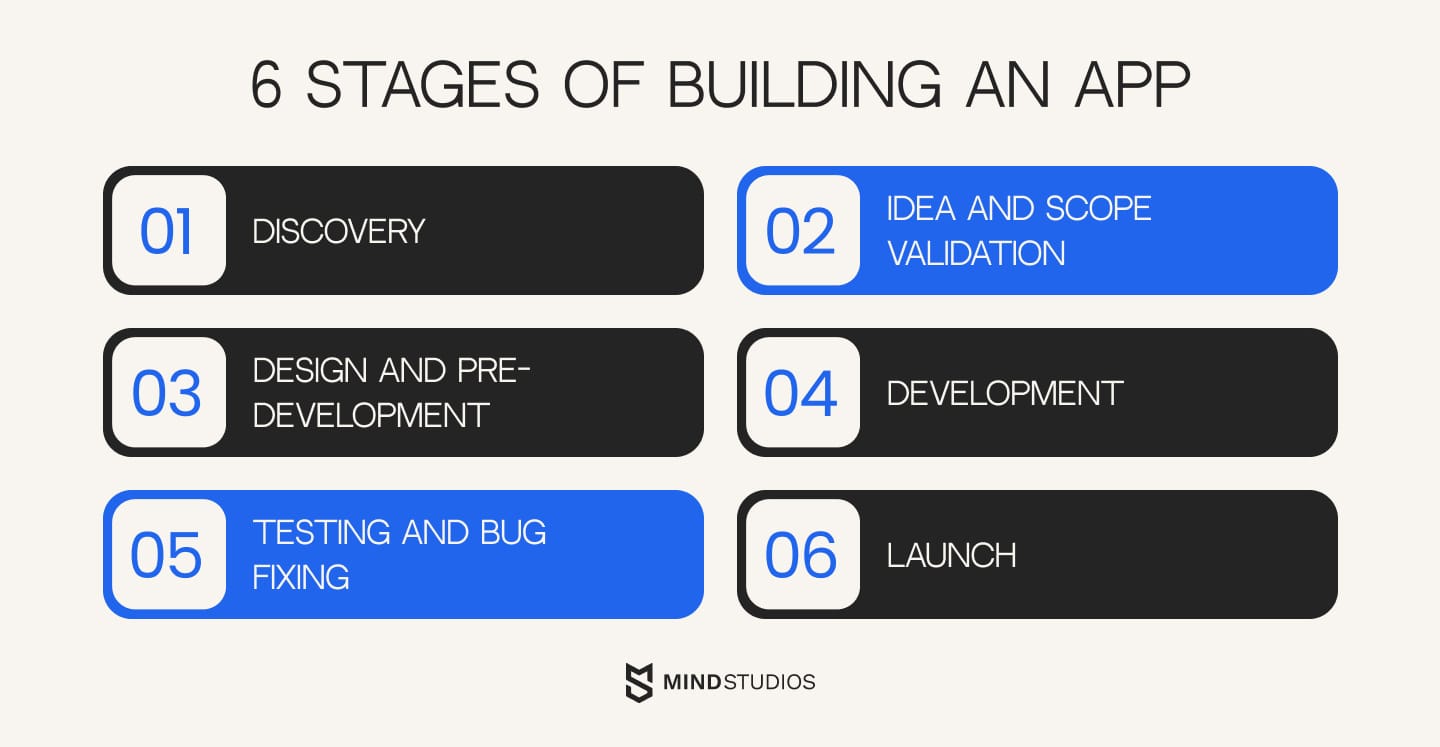
Three of those six stages happen before development starts. That is by design. The planning phase is what turns ‘somewhere between three and six months’ into an actual timeline you can build a hiring plan or an investor update around.
In the next section, we break down how many weeks or months each stage typically takes in 2026.
How long each stage takes in 2026
Ranges vary by scope, but breaking down average app development time by stage makes most builds follow a similar shape when the spec is clear.
- A simple, single-feature app can land in 2–4 months end to end.
- A complex or regulated product (multi-role, integration-heavy, or compliance-bound) typically runs 7–12+ months.
Everything in between follows the six stages below.
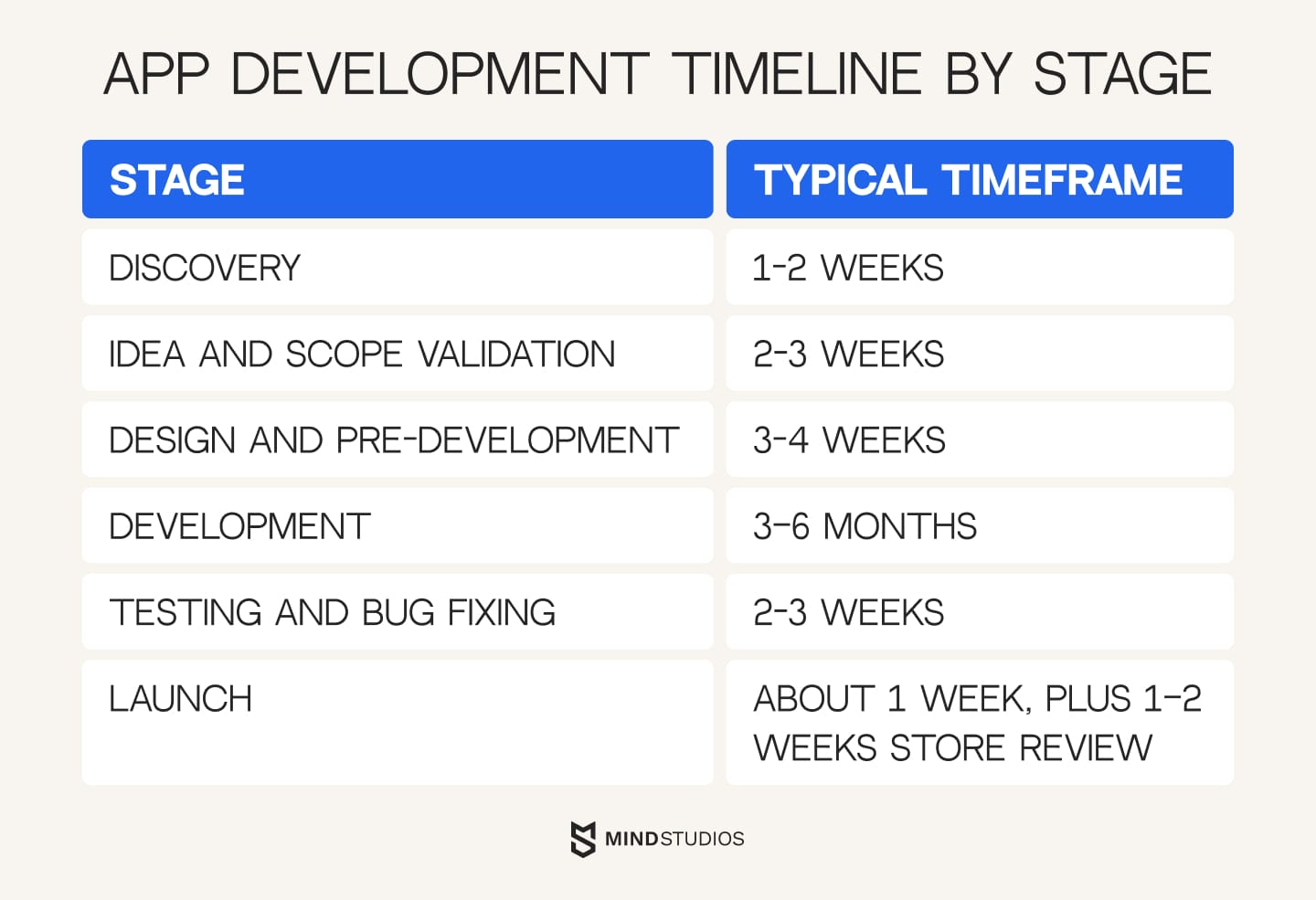
Discovery: 1–2 weeks
This is where research turns an idea into something buildable. Our team learns the product's goals and target users, maps the core flows, flags risks early, and writes the requirements every later estimate depends on.
This is also the stage most responsible for whether your final date holds — teams that treat discovery as a formality are the ones whose ‘3 to 6 months’ turns into nine.
Our business analysis and IT consulting work is built specifically around this stage.
Idea and scope validation: 2–3 weeks
If your product already has traction, this stage validates the specific scope and technical approach, not whether anyone wants the product, since you already know that.
It means pressure-testing the feature list against real user flows, building a clickable prototype to catch usability gaps before development, and confirming the navigation concept matches what your team actually needs to build. This is where scope creep gets caught early, before it becomes a delay three months in.
Design and pre-development: 3–4 weeks
With the scope validated, this stage turns it into a high-fidelity prototype — full UI and UX design, ready for engineering handoff.
It typically runs 3–4 weeks, and the time invested here pays off directly in the next stage: a clear design spec means fewer mid-development decisions, and fewer mid-development decisions means fewer delays.
Development: 3–6 months
This is usually what people mean when they ask 'How long does it take to develop an app?', but development is only one of six stages, and the most variable one.
- A minimal feature set with a simple design can come in well under three months.
- A multi-role platform with several integrations, custom backend logic, and a compliance layer can run past six.
This is also the stage most affected by AI-assisted tooling in 2026 — more on that in the next section.
Testing and bug fixing: 2–3 weeks
Testing should not be a single pass tacked onto the end. Teams that test only after development finishes tend to find structural bugs late, when fixing them means reworking components other features already depend on.
Ongoing testing throughout development keeps this final stage to what it should be: 2–3 weeks to catch what is left, not to uncover fundamental issues.
Launch: about 1 week, plus store review
Launch itself takes about a week once the platform decision from earlier stages is locked in. App store review adds another 1–2 weeks on top, and that part is outside your control — the App Store applies stricter review standards than Google Play, so build the buffer into your date rather than treating it as a surprise.
How AI actually changes the timeline in 2026
You have probably heard that AI builds apps in days. That is not wrong, exactly. It is just half the story.
| AI speeds up | AI does not speed up |
|---|---|
| Boilerplate code | Discovery: still takes a human who understands your business. |
| First-pass UI components | Testing: still needs real people using real flows. |
| Basic API integrations | Production-quality review: someone experienced still has to catch what AI got wrong. |
| Test scaffolding | Architecture decisions on how components fit together |
| Documentation drafts | Compliance and security judgment calls |
Work that used to take a week can now take a day or two, if you have an engineer who knows what to check.
What AI skips over is usually what decides whether the app actually works for your users — in production, that gap can be the difference between a working feature and a security hole.
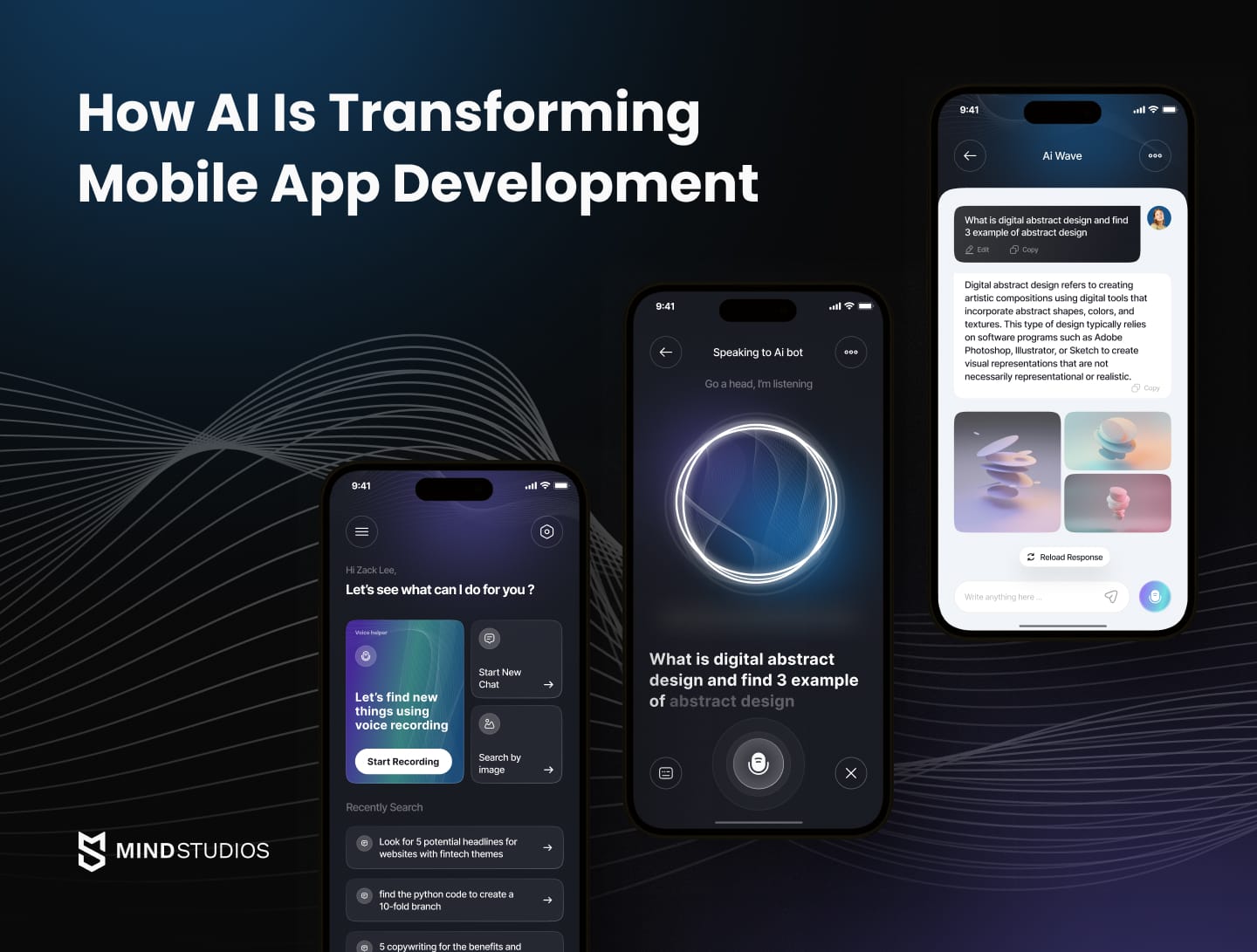
Two very different starting points
‘AI builds apps in days’ usually describes one of two things, and they are not the same product.
A no-code AI prototype can genuinely go from idea to a clickable demo in a day or two: useful for pitching, useless for shipping. Turning that demo into something that handles real users, real data, and real edge cases is a separate build, and it still runs through discovery, design, development, and testing like any other product. Skipping straight from prototype to launch is how teams end up rebuilding the same app twice.
What this means for your timeline
An AI-built prototype can look finished in days and still take months to actually be ready. Used with expert supervision, AI is a real time saver — our engineers use it daily for exactly the tasks in the table above. Used alone, without someone who knows where to stop trusting it, it just moves the delay somewhere less visible: past launch, into your support inbox.
For engineering leads
The time savings show up in implementation, not in architecture or requirements. That is still where senior judgment helps most, and where quality gets decided — an AI model has no stake in your product working six months from now.
If you are weighing how much of your build AI can realistically handle, contact us and we will walk through your specific scope.
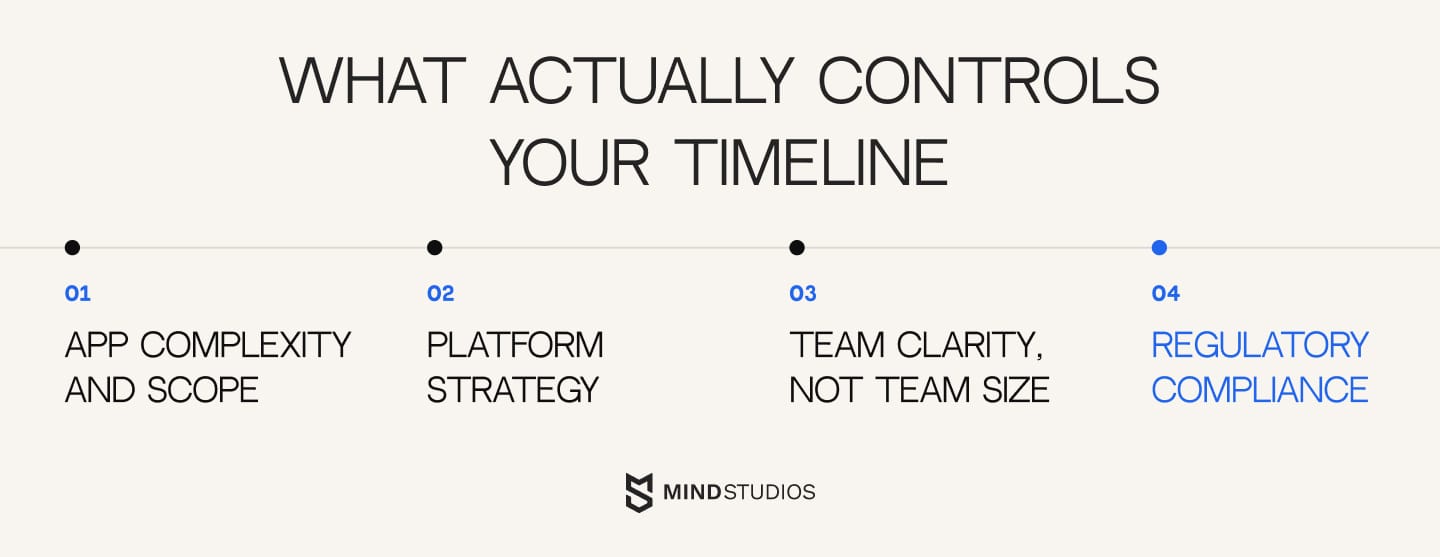
What controls your app development timeline
Some of these you control. Some you do not. Knowing which is which is most of what keeps a date realistic.
App complexity
This is the biggest single lever.
A tight feature set with a simple design moves fast. Add multiple user roles, real-time data, or several third-party integrations, and the timeline stretches accordingly, not because of scope for its own sake, but because each integration point is something that can break, and each one needs its own testing.
If you need complex functionality on a tight date, integrating an existing service is usually faster than building it from scratch, though it is worth vetting any third-party dependency before you commit to it.
Platform
Building for one platform first keeps the original range intact.
Building for one platform, then deciding later to add the other, effectively restarts the clock on a second build. Building for both from day one does not double your timeline the way it sounds like it should, since iOS and Android development largely run in parallel.
Cross-platform frameworks like React Native or Flutter can cut 30–40% off the combined timeline by sharing one codebase across both — the trade-off is some limits on what is technically functional on each platform, which is worth weighing against your speed needs.
Team size and scope clarity
The instinct is to add developers to go faster. In practice, the bigger lever is scope clarity.
A tightly scoped project from a solid discovery phase moves faster with a small team than a loosely scoped one does with a large one, because a large team working from an unclear spec spends its extra hours on rework, not progress. What you control as a client (clear, timely answers when your team needs a decision) moves your date more than headcount does.
Regulatory compliance
If your product is going into healthcare, finance, or another regulated space, build in extra time. HIPAA, GDPR, and similar requirements add real steps (like data handling reviews, access controls, or audit trails) that a non-regulated build does not need. Depending on the requirement, that can mean anywhere from an extra week to an extra month.
Our guide on HIPAA-compliant development covers what that adds in more detail.
If your build touches regulated data, contact us early. It is far cheaper to plan for it at discovery than to retrofit later.
James: building four apps against one fixed date
Deadlines do not compress the work, they compress the room for error. James worked because we spent the first weeks getting the scope right, not because we skipped anything later. Once the scope is locked, a tight timeline is just a scheduling problem: you know what needs to happen and in what order. The dangerous deadlines are the ones where nobody has actually agreed on what 'done' means yet. That is where teams start cutting testing or skipping discovery, and it always costs more time than it saves.
— Anton Baryshevskyi, CBDO at Mind Studios.
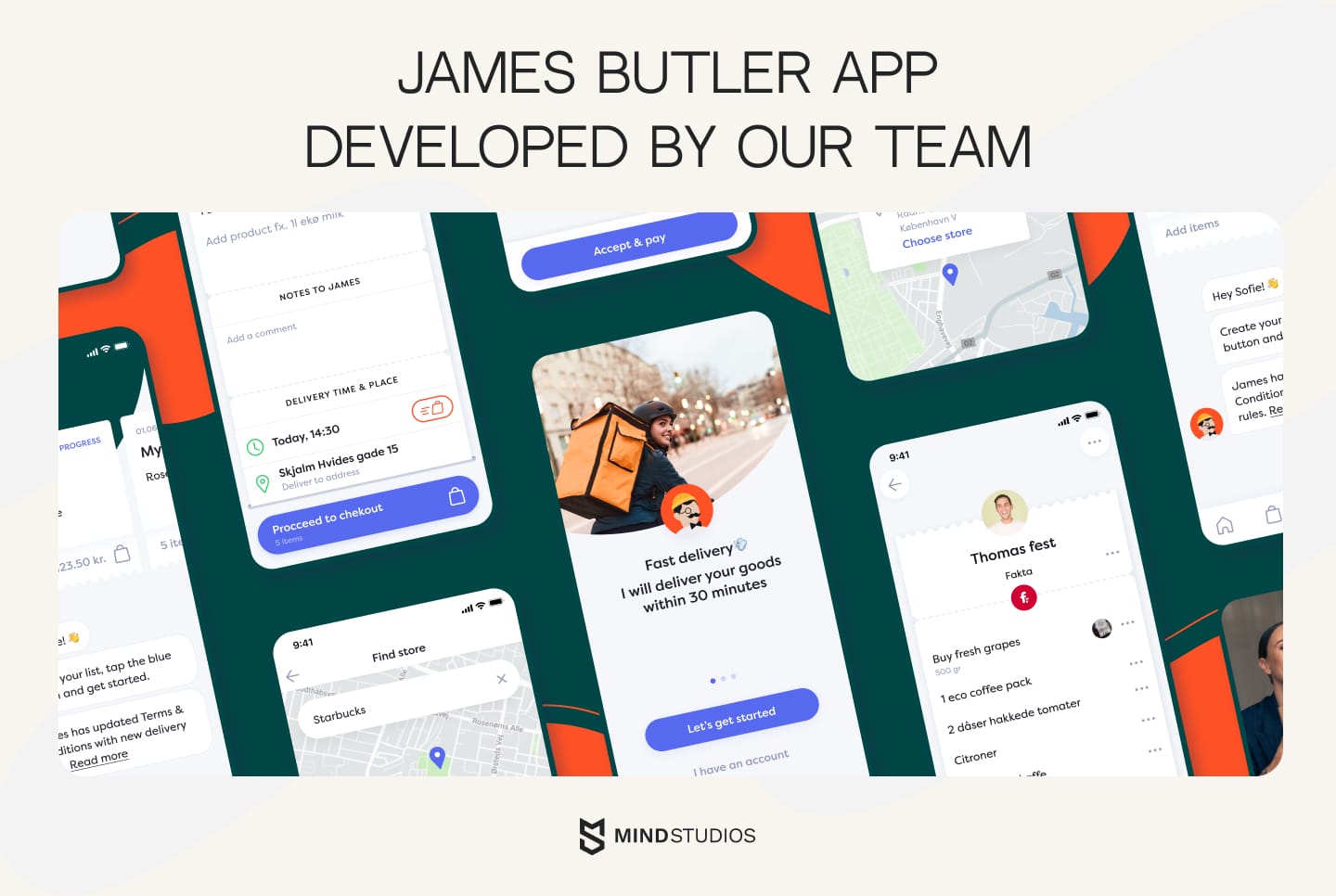
James Butler (or simply James) is an on-demand delivery app built for the Danish market — order groceries or goods from local stores, no need to specify which brand or which shop, delivered fast. Our client came to us with the product already defined and a hard constraint: a fixed external deadline, with no room to renegotiate the date once development started.
Why it was four apps, not one
That gave us a hard three-month timeline and four apps to build within it. Delivery apps need two sides: one for customers, one for couriers. Add native iOS and Android for each, and the plan covered four separate builds running in parallel, not sequentially.
How the schedule held
We built the schedule backward from the deadline, not forward from a generic estimate.
Discovery moved fast because the scope was already clear. Development ran across both platforms at once with dedicated teams per app, and testing happened continuously rather than as a single pass at the end. Three months later, all four apps launched on schedule — proof that the deadline was never the risk once the scope was locked.
The takeaway
This is the same lesson behind every stage breakdown above: a real date is not a guess dressed up as a range. It comes from knowing your scope well enough to plan backward from the day you actually need to launch.
Explore our full portfolio.
The bottom line on your timeline
A generic timeline ‘three to six months’ is not a plan, it is a shrug. The teams that hit their launch date are the ones who spend the first few weeks getting scope right, not the ones who skip ahead to development.
Across most builds, the shape looks like this:
- Discovery: 1–2 weeks
- Idea and scope validation: 2–3 weeks
- Design and pre-development: 3–4 weeks
- Development: 3–6 months
- Testing: 2–3 weeks
- Launch: about 1 week, plus store review
Where you land in that range depends on complexity, platform decisions, and how clear your scope is going in: all things covered above, and all things a real discovery conversation will tell you far more precisely than any article can.
That is the honest answer to how long this takes: it depends, and the only way to know for your specific build is to talk it through with people who have shipped experience-backed products on a deadline before.
If you have a launch date in mind, book a free consultation and we will walk through your scope, map out realistic stage estimates, and give you a timeline built around your actual product, not a generic range.