
 ChatGPT
 Perplexity

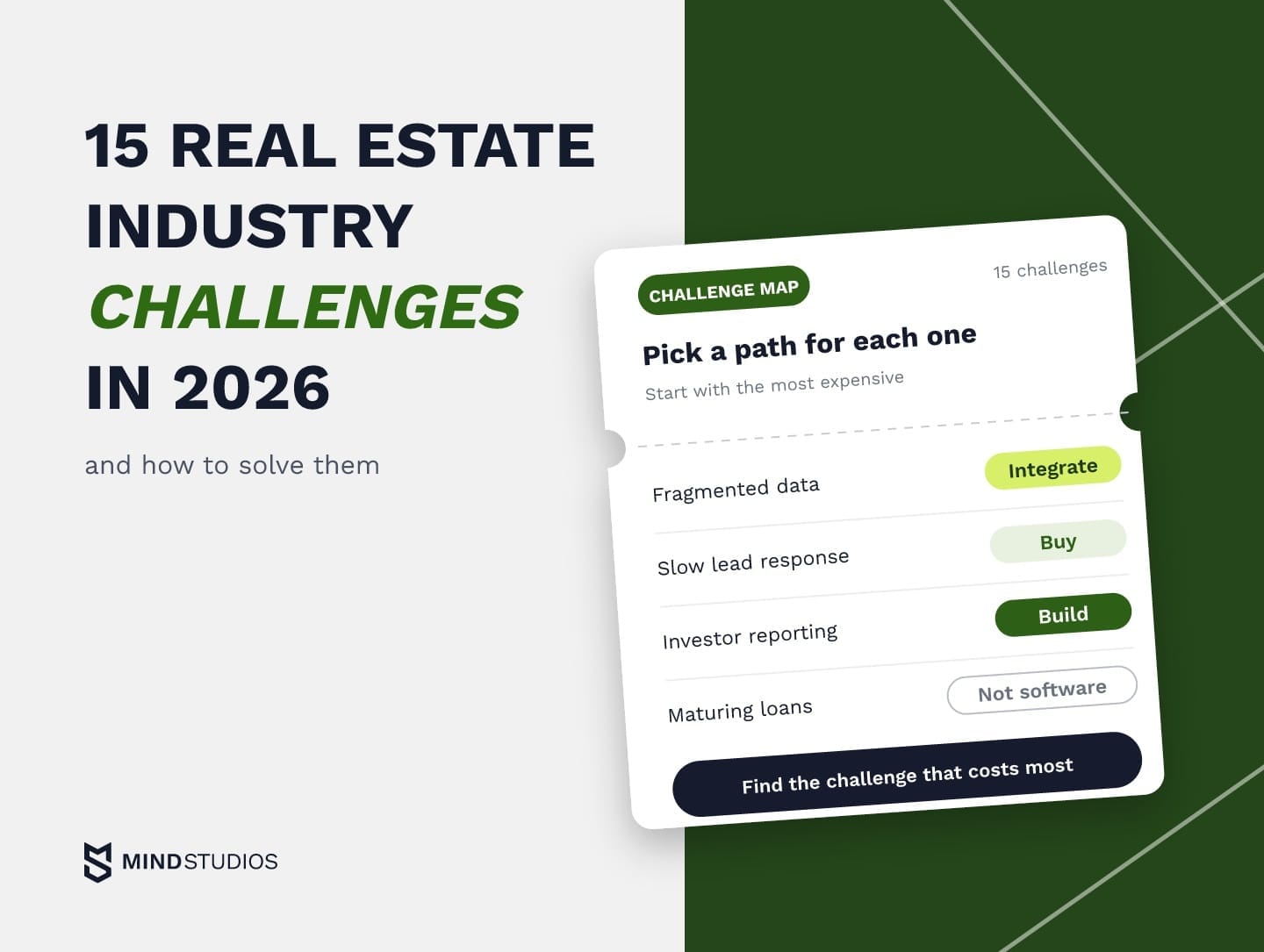
Fifteen real estate industry challenges in four groups shape 2026: market and financing, operations, clients and revenue, technology and risk. See which ones software solves and which path fits each.
Highlights
- Rates, maturing debt and costs sit outside software; faster data shapes the response.
- Most internal real estate challenges trace back to systems built for manual coordination.
- Pick the first project by recoverable loss, then integrate, buy or build.
This year's pressures come in two kinds. Rates, maturing debt, construction costs and affordability sit outside any system you can install. Scattered data, slow reporting, lost leads and idle units are internal real estate problems, and integration, packaged tools or a custom build can fix most of them.
A missed inquiry makes the workflow gap visible. One operator offers tour slots the same evening. Another leaves the message in a shared inbox overnight, and the prospect books with the first operator before the second team replies.
We've built real estate products for several markets, including the Mulki platform for MENA landlords and the AnyCurb marketplace for US listings, which runs a likely-to-sell model.
If one of these challenges already shows in your numbers, the next question is where software will pay off first.
What are the biggest real estate industry challenges in 2026?
The biggest challenges this year come from two directions. External pressures such as interest rates, maturing debt, rising costs, affordability and policy shifts shape the whole market. Internal ones decide how well each operator copes: scattered data, slow reporting, manual back offices, lost leads, idle units, ungoverned AI, fraud, ESG reporting and growth.
The Counselors of Real Estate rank fiscal and monetary policy first in their Top Ten Issues for 2026. They point to segments that still struggle, such as for-sale housing, lower-tier offices and maturing loans that are hard to refinance. That issue sits outside any operator's control, while data and workflows sit inside it.
The table shows what software can address in each of the 15.
| Challenge | Software impact | Usual path |
|---|---|---|
| Financing costs and maturing loans | No; data speeds up refinancing | Not a software problem |
| Rising insurance, construction and labor costs | No; budgets show the impact sooner | Not a software problem |
| Housing shortage and affordability | No; payment data flags risk early | Not a software problem |
| Shifting demand and regulatory uncertainty | Partly, through scenario models and lease rules | Integrate |
| Fragmented data and disconnected systems | Yes, by removing repeated entry | Integrate, then build |
| Slow financial and investor reporting | Yes, by consolidating sources | Integrate or build |
| Lease administration and back-office overload | Mostly, for dates, notices and escalations | Buy, or build for unusual leases |
| Transaction paperwork and document handling | Yes, for signing and version control | Buy and integrate |
| Reactive maintenance and property operations | Mostly | Buy and integrate IoT |
| Slow lead response and CRM gaps | Yes, for routing and tracking | Buy or build, then integrate |
| Vacancy, pricing and inventory management | Partly; weak demand stays a market issue | Integrate or build |
| AI adoption without governance | Partly; governance is also process | Build controls into AI features |
| Cybersecurity and payment fraud | Partly; controls plus training | Buy and integrate |
| ESG and regulatory reporting | Partly, for data collection | Integrate or build |
| Scaling across properties and markets | Partly, through configurable market rules | Configure, integrate or build |
Three of the 15 sit outside software's reach and a fourth only partly, so these four come first.
Market and financing challenges software cannot fix
Interest rates, maturing loans, construction costs and housing affordability are commercial real estate challenges that no platform removes. Software changes how quickly an operator sees the impact and answers a lender, investor or regulator. The table pairs each market force with sourced data and the part an operator still controls.
Market force |
Sourced data |
Operator controls |
|---|---|---|
Interest rates |
Fed's September projections: 4.1% median federal funds rate, end of 2026 and 2027 |
Debt service modeled at current rates, updated quarterly |
Loan maturities |
MBA data: $875 billion maturing in 2026 |
Lender-ready data package well before maturity |
Construction costs |
AGC analysis: nonresidential input prices up 11.9%, September 2025 to September 2026 |
Capex and renovation budgets re-priced against live bids |
Affordability |
NLIHC's Out of Reach: $33.63 an hour, the 2025 housing wage |
Delinquency and renewal risk tracked by unit |
Rent rules |
REGA's provisions: five-year Riyadh rent freeze from September 25, 2025 |
Pricing logic recording the rule applied to each lease |
Each force gets its own subsection below, starting with debt.
Financing costs and maturing loans
When rates stay high and many loans come due at once, refinancing becomes one of the most expensive events on an owner's calendar. MBA's 2026 maturities equal 17% of commercial and multifamily mortgage balances.
That total is 9% below the $957 billion that was scheduled to mature in 2025, so the wave is easing while staying large. NAR's summary of the Counselors' list expects the hardest refinancing in private debt markets.
A loan written when money was cheap now resets higher, and no software changes that math. What software can shorten is the time between a lender's question and your answer. When rent rolls, delinquency history and capex records come from one system, the package arrives already reconciled.
Rising insurance, construction and labor costs
AGC links the construction-cost increase in the table to fuel prices and tariffs on metals. Insurance pressure comes from somewhere else: the Counselors' portfolio risk issue lists insurance, extreme weather and natural disasters among the risks investors now weigh.
Labor adds a third pressure. In the AGC workforce survey, 92% of contractors reported trouble filling open positions and 45% said shortages were delaying projects. A crew that arrives weeks late keeps a unit offline, so turnover plans need contractor lead times built in.
All three costs land in the renovation plan and the operating budget. A budget that pulls in current vendor bids and flags variance by property shows the gap before owners commit to the work.
Housing shortage and affordability
The Counselors' housing issue ties affordability to a shortage of homes and sees no single fix, pointing to land use, zoning and entitlement reform that only policymakers can deliver.
An operator adds supply only through its own pipeline, where feasibility models show whether a project still works at current costs and rents. On existing units, affordability pressure shows up in the books before it shows up in a vacancy report.
The housing wage in the table refers to a modest two-bedroom rental. NLIHC also counts about 22.4 million cost-burdened renter households, 12 million of them severely burdened.
With payment patterns and renewal responses tracked per unit, a manager sees who needs a payment plan conversation before a missed payment becomes a turnover.
Shifting demand and regulatory uncertainty
Demand and rules can both move during a lease term. The Counselors expect rates, tariffs and global shifts to keep slowing investment and demand, alongside slower population growth, migration and household formation.
Take a multifamily owner whose submarket sees household formation slow: two-bedroom renewals slip while one-bedrooms keep leasing. With leasing and lease data in one model, the owner can test repricing, refitting units or delaying the next acquisition before the shift reaches the vacancy report.
Rules move just as fast. The REGA package that froze rents within Riyadh's urban boundaries also requires landlords to register unrecorded leases on the Ejar platform and limits the grounds on which a Riyadh landlord can refuse renewal. Lease software therefore needs notice deadlines, refusal rules by market and a record of which rule applied.
Mind Studios' insight: Market forces hit every owner in a submarket at once, so the advantage goes to whoever sees the impact first. If refinancing delays are the largest recoverable loss, we'd first connect the rent roll and debt schedule to their source systems, which gives lender packages and scenario models a shared baseline.
Operational challenges that drain margin
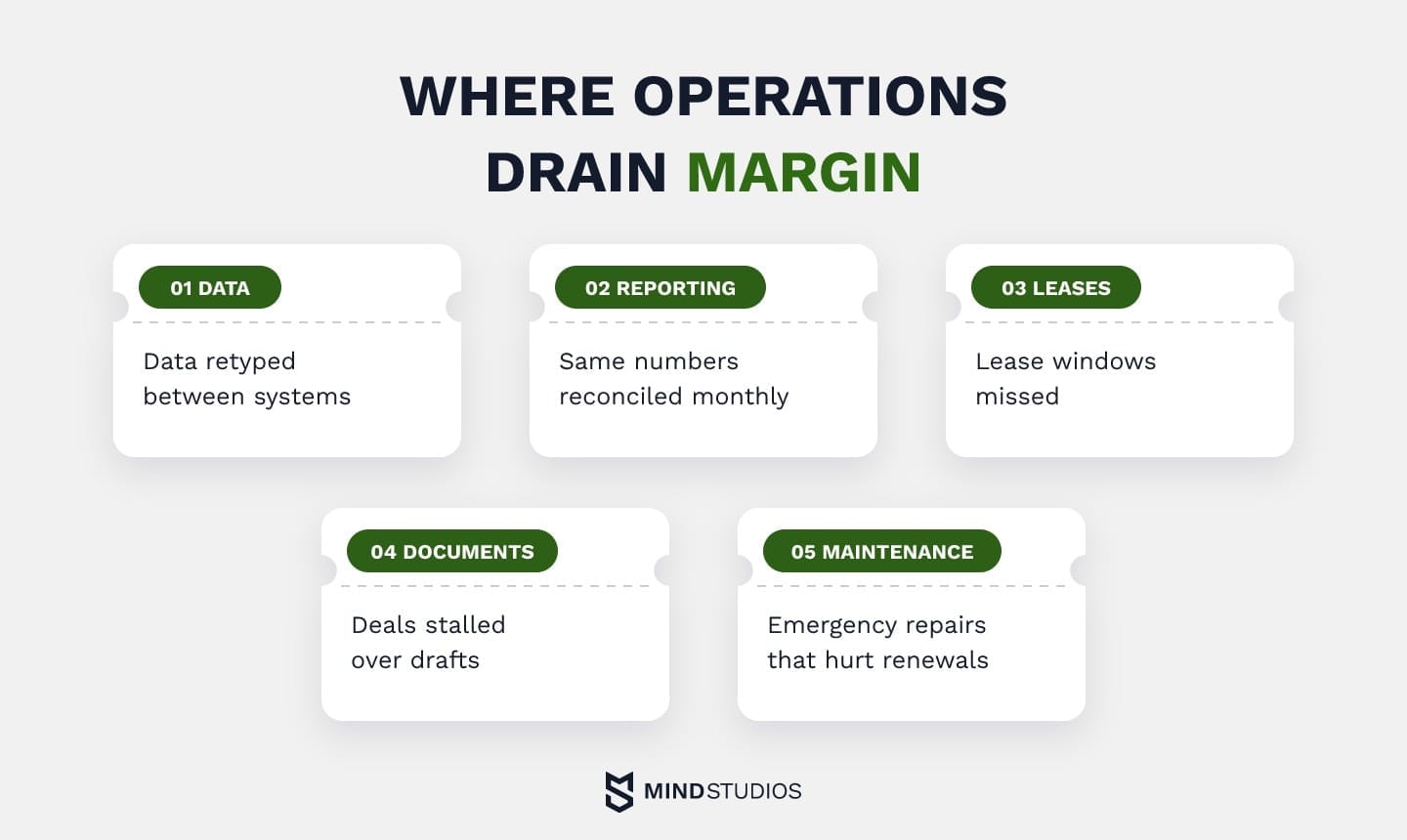
Inside the company, fragmented data and a back office that runs on manual handoffs create costs an owner can count in staff hours and missed revenue. Integration, workflow automation and a single data model address them, which is why these operational real estate problems are usually where software payback is easiest to measure.
Fragmented data and disconnected systems
Most operators run leasing, accounting, maintenance and investor reporting in separate tools. The Counselors' technology issue stresses that owners need control over data from fragmented sources before AI can help them. At every handoff between systems, data gets retyped, delayed or lost.
The fix usually starts with integration: APIs between the systems you keep, a shared property and unit ID, and one reporting layer on top. A custom platform makes sense when the tools you own can't represent how your business works, for example with region-specific lease formats or payment calendars.
Mulki shows the custom route: property owners in the MENA region were juggling several apps and spreadsheets, with no unified view of leases, finances or portfolio performance. We built one mobile platform that combines:
- Tenant management: automated
- Contract scanning: AI-powered
- Payment schedules: based on the Hijri calendar
- Interface: Arabic RTL
- Financial dashboard: real-time, across properties
Mulki launched as an MVP.
Slow, error-prone financial and investor reporting
Reporting gets harder as soon as a portfolio answers to more than one owner, lender or fund. Each stakeholder wants the same data cut a different way, so finance teams export, reconcile and reformat the same numbers every month. That costs analyst days and produces reports that contradict each other.
In many companies the general ledger sits in an ERP, which handles entities and consolidation well but carries little unit-level leasing detail. The software path is a reporting layer that reads directly from the ERP and the property management system, with investor and lender views built on shared definitions of occupancy, NOI and arrears.
Red flag: When two reports from the same month show different occupancy for one property, compare their definitions, cutoff dates and source records first. A new dashboard on top carries those differences forward unless the team resolves them.
Lease administration and back-office overload
When lease administration runs on email and spreadsheets, the workload grows with every unit. Renewals, escalations, deposits and notices all depend on someone remembering them, so missed windows quietly cost revenue.
For standard residential or commercial leasing, a property management system covers most of this out of the box, so buying is the sensible default. Building pays off when your lease structures, fee rules or local regulations fall outside what packaged systems handle.
Our guide to property management software covers that decision.
Transaction paperwork and document handling
Acquisitions, dispositions and new leases produce documents that pass between brokers, lawyers, lenders and tenants. When versions live in email threads, deals stall over which draft is final, and audits turn into searches.
E-signature tools and a cleanly indexed document management system solve most of this, and both are mature products to buy and connect to your CRM and accounting.
Custom work pays off in document extraction. An LLM can pull key terms out of thousands of leases, but each extracted term needs a review against the source clause before it feeds a rent roll.
Blockchain belongs on the roadmap only when a fund sponsor has a concrete tokenization plan. Deloitte's tokenization forecast expects $4 trillion of real estate to be tokenized by 2035, and any such offering would rest on the same indexed title and lease records.
Reactive maintenance and property operations
Maintenance turns reactive when the first sign of a failing boiler is a tenant complaint. Emergency repairs cost more and hurt renewals. The Counselors also note that getting data out of building systems has proven difficult, which is where many IoT plans stall.
A practical path starts with work order software that every technician actually uses. IoT sensors come next, on the few systems behind most emergency calls, connected through the building management system's API. Predictive models come last, once there is enough clean history to train them.

Client and revenue challenges
On the revenue side, operators lose prospects to slow responses and lose rent to units that sit empty or carry the wrong price. Software handles these client-facing real estate challenges well: a CRM that routes every inquiry immediately, and inventory data that shows demand, with documented pricing rules and a person reviewing each change.
Slow lead response and CRM gaps
Leads arrive from listing portals, websites, phone calls and walk-ins, often into different inboxes, which is how the slower operator in the opening loses the tour.
A CRM closes that gap by capturing every inquiry in one place, assigning it to an agent or an automated first reply and tracking it through tour, application and lease. Adoption decides whether it works: if agents have to log the same activity twice, they may leave one system incomplete, which makes the pipeline harder to trust.
Buying works when your sales process is standard and the CRM connects to your listing feeds and property management system. Building makes sense when lead routing follows your own rules, such as property type, language or region.
Our article on real estate CRM development walks through both options.
Vacancy, pricing and inventory management
Every day a unit sits empty is rent the operator never gets back. Improvement usually happens in four stages, and jumping ahead without the earlier data rarely works:
- Real-time availability: one live view of unit status across all properties.
- Pricing recommendations: rates suggested from occupancy, seasonality and local comparables, with staff approving every change.
- Turnover forecasting: lease expirations, payment patterns and maintenance requests used to predict vacancies, so marketing and renovation start earlier.
- Portfolio allocation: marketing and capex budgets moved to the properties where they earn the most.
Red flag: Algorithmic pricing now carries legal risk in the US. On May 19, 2026, a federal court entered the final judgment that resolves the Justice Department's claims against RealPage.
Under the settlement terms the department announced, RealPage software can't use competitors' nonpublic, competitively sensitive data in live rent recommendations, and model training is limited to such data aged at least 12 months.
Pricing logic also has to respect the Fair Housing Act, which bars discrimination in rental terms and conditions. In practice, a pricing model needs documented inputs, an audit trail and an owner who reviews outcomes by unit type and location.
Technology, data and risk challenges
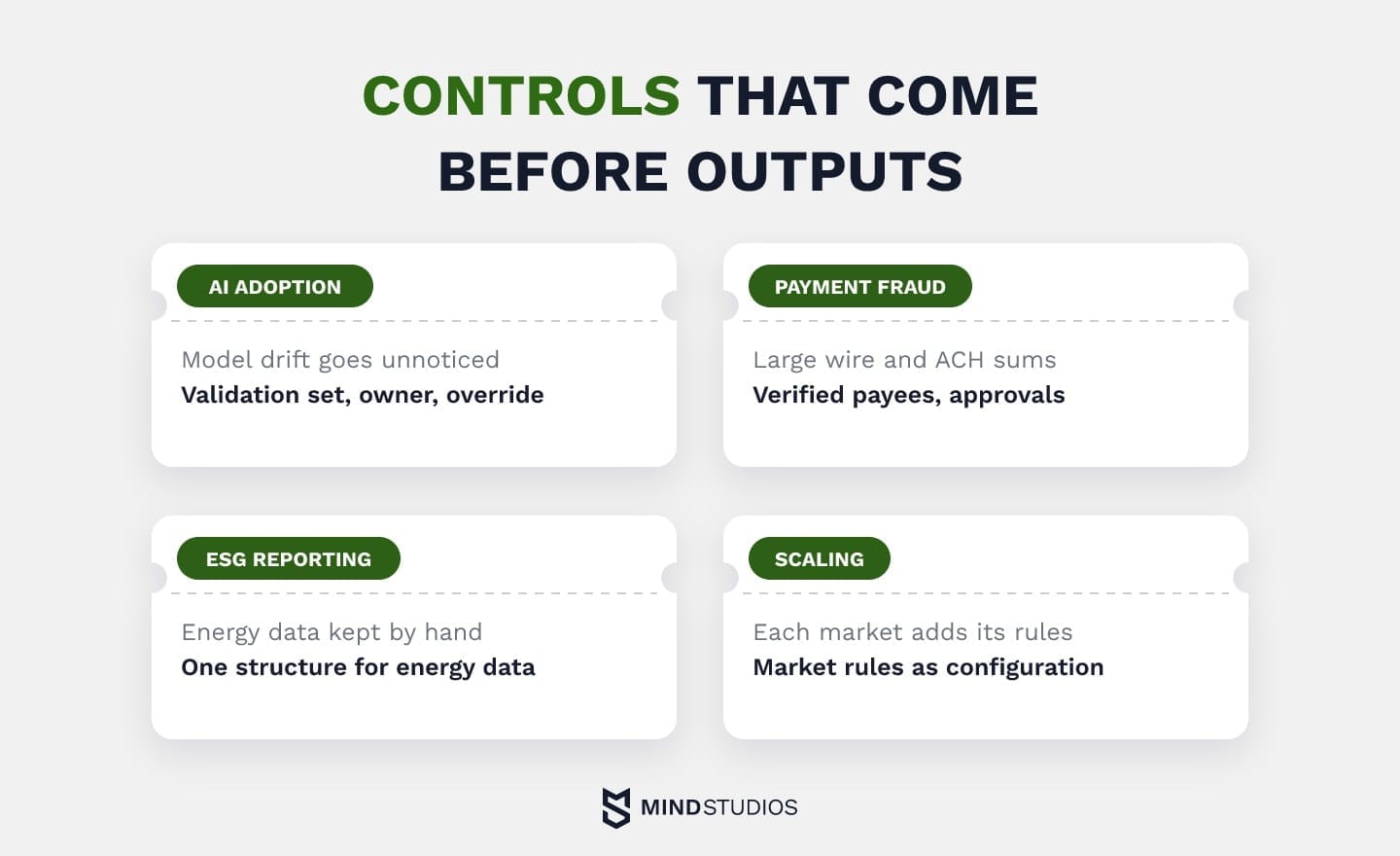
AI adds new control requirements to older challenges in real estate operations such as fraud, regulatory reporting and portfolio growth. In all four areas, a poorly designed system can spread one error across a whole portfolio. Ownership and checks come before outputs reach lenders, regulators or residents.
AI adoption without governance
Real estate firms are testing AI faster than they set rules for it. Deloitte's CRE outlook, a survey of 950 executives at owners and investors with at least $250 million under management, finds that 92% are still researching or piloting AI and only 8% have integrated AI solutions.
The survey's heading puts it plainly: "AI governance in CRE lags AI innovation." Fewer than half of respondents have stronger controls in place, such as challenger models, exception handling or detective controls, so drift in a pricing or screening model can go unnoticed.
Validation is one of those controls. AnyCurb's likely-to-sell algorithm scores homes on 300+ metrics, and a third party verified its 85% prediction accuracy.
Mind Studios' recommendation: Give every AI feature a validation set, an accountable owner and a way to override its output before it reaches residents or prices. Those controls let your team test on a small scope first and widen use once results hold.
Cybersecurity and payment fraud
Real estate moves large sums by wire and ACH, which makes it a constant target. The FBI's IC3 report recorded more than $275 million in real estate fraud losses across 12,368 complaints in 2025. The AFP survey found that 76% of US organizations faced attempted or actual payments fraud that year.
Software reduces this risk through verified payee data, separate-channel confirmation of any bank detail change and role-based payment approvals.
Applicant verification belongs here too. On the Rentorr platform, a long-term rental product, we built a fraud check in which a partner bank assessed whether applicants could pay rent and returned a credibility score.
A development partner will handle payment flows and applicant data, so ask which certified processes back its work. Mind Studios is ISO 27001 and ISO 9001 certified.
ESG and regulatory reporting
In the EU, member states had to transpose the revised buildings directive into national law by May 29, 2026. It requires renovation of the 16% worst-performing non-residential buildings by 2030 and the 26% worst-performing by 2033, so owners need per-building energy data that many portfolios still collect by hand.
In the US, the SEC stayed its 2024 climate disclosure rules during litigation, and in May 2026 it proposed rescinding them entirely. Until that proposal becomes final, it makes sense to keep energy and emissions data in one structure that can feed EU filings, lender questionnaires or a revived US requirement.
Compliance tooling usually matures in three steps:
- Monitoring tracks consumption after the fact.
- Automation collects meter data, flags deadlines and generates filings.
- Compliance by design builds the rules into procurement, maintenance and capex approvals.
Most portfolios should reach automation first. Compliance by design pays off in large portfolios that span several markets.
Scaling across properties and markets
A new market brings its own lease law, currency, language and payment calendar, and a new property type brings different metrics. A shared data model, with market rules handled as configuration, lets a platform absorb that growth without multiplying tools.
A packaged property platform or ERP with multi-entity and multi-currency support adds companies, ledgers and currencies through settings. A custom layer is justified when a market rule changes how a lease or payment behaves, such as Hijri payment schedules, because configuration can't express logic the product never modeled.
Real estate industry solutions: integrate, buy or build?
Integrate when your current systems work well and offer usable APIs. Buy when the process is standard across the industry and a mature product covers it. Build when your processes and data have become an advantage that packaged tools can't represent.
The market for real estate software solutions is crowded, so choosing the path matters more than choosing the vendor. Four criteria decide it, and the table applies them to each path:
- System count: how many systems you run
- API availability: whether they offer usable APIs
- Process differences: how far your processes differ from industry practice
- Data ownership: who owns the data
| Path | When to choose | Requirements and risks |
|---|---|---|
| Integrate | Solid core systems with APIs; data split across them | Shared IDs, integration layer; vendor API changes break it |
| Buy | Standard process: accounting, e-signature, basic leasing, work orders | Configuration, change management; vendor dependence |
| Build | Lease structures, pricing rules, markets or data model set you apart | Discovery, ongoing partnership, code and data ownership; higher cost, longer launch |
The risks differ in kind. Buying bends your process to the product and ties it to the vendor's roadmap and pricing, while building brings a higher upfront cost and a longer first release.
Digital solutions for real estate rarely come down to a single choice. A typical mix buys accounting and e-signature, connects them to the property management system and builds only the layer that is unique to the business, such as pricing rules or investor reporting.
Our guide to tech optimization goes deeper into extending the software you already run.
When the answer is to build, custom software development should start with the most expensive challenge and the data model behind it. That keeps the first release small and leaves the platform open for the next one.
Mind Studios' recommendation: Before you buy a new tool or start a build, list every system that touches a unit from listing to move-out and note who owns its data. If two systems report different rent or occupancy, agree first on the metric's owner, cutoff date and calculation. Integration is the next step when the mismatch traces back to delayed or missing updates.
If you're weighing these paths for a specific portfolio, the deciding question is how your current systems hold up against all three options before you commit a budget.
Where to start: find the challenge that costs you most
Start with a problem you can measure in hours or money and that software can actually reduce. A loss with a number attached gives you a baseline and a business case. The first project still depends on how much of that loss a system can recover.
The questions below turn vague complaints into figures you can set against the cost of IT solutions for real estate, whether you buy, integrate or build them:
- How many staff hours a week go into copying data between systems?
- How many days does an average unit sit empty between leases?
- How long does a new lead wait for a first response, by channel?
- How many days does it take to assemble a lender or investor package?
- How many core systems run without an integration to the rest?
- What share of monthly maintenance calls are emergencies?
From symptom to first project
These answers show where losses build up, but they don't rank projects on their own. A four-step filter turns each symptom into a decision:
- Current loss: hours, rent or deals lost per month, taken from your own records.
- Recoverable share: the part of that loss caused by workflow or data, which software can remove.
- Cost to implement and run: licenses or build, integration, training and ongoing support.
- Dependencies and risk: data to clean first, systems without APIs, staff adoption.
Vacancy shows why the second step matters. If units sit empty because listings go live days after move-out and make-ready work waits on vendors, turnover alerts and work orders can close much of the gap. If local demand has weakened, software can compare pricing, concessions and leasing activity, while the owner still decides whether the property's offer fits that demand.
Dmytro Dobrytskyi, CEO at Mind Studios, adds a data filter learned on builds such as AnyCurb's likely-to-sell model:
Owners usually rank problems by how much they hurt. We also ask where the data for the fix comes from and who keeps it accurate, because a model or dashboard can't be more reliable than its inputs. If those inputs live in spreadsheets that several people edit, cleaning that source is the real first project, and it makes every later feature cheaper to trust.
Bottom line
The missed inquiry from the opening is a loss an operator can trace and fix. The same method separates workflow delays from market pressures that software cannot remove: rates, debt and costs stay outside any system, while speed, data quality and controls are yours to change.
A first project tied to a measurable loss and an agreed baseline keeps real estate industry solutions accountable to results.
Our real estate experience covers landlord platforms, listings marketplaces and rental products in several markets.
If you already know which problem costs you most, the next step is scoping the first project around it during discovery.
FAQ
What is the biggest challenge in the real estate industry right now?
For the market as a whole, the Counselors of Real Estate rank fiscal and monetary policy first for 2026. For a single operator, the biggest challenge is the one with the largest recoverable loss, and only its own records show which one that is: hours of rework, empty unit days or a slow lender package.
What are the main challenges in real estate for property management companies?
Property management companies feel operational and client-side pressure most, and a few records show which pressure costs the most:
- Renewal rate and notice dates by property
- Arrears by age bucket
- Work order time from open to close
- Corrections to owner statements per month
- Leads lost before a tour, by source
Which real estate industry challenges can software actually solve?
Software solves challenges that come from how work moves inside a company, when a few conditions hold:
- Scattered data, when systems expose APIs or reliable exports
- Manual reporting, when teams agree on metric definitions first
- Lead handling, when agents work every channel in one CRM
- Pricing support, when data is verified, rules are lawful and results are monitored
- Payment controls, when approvals are enforced in the workflow
What are the most common real estate problems and solutions?
The common pairs are scattered data and integration, slow lead response and a CRM, and reactive maintenance and work orders. Automation should wait while the process still changes every few months, while teams disagree on how a metric is calculated or while key fields are typed by hand without validation. Otherwise automation repeats the error at scale.
How is AI affecting the real estate industry?
AI shows up first in tasks whose output a person can check: pricing suggestions, first replies to leads, lease abstraction and maintenance forecasts. Results depend on the inputs. When records are scattered, the team first reconciles the data a feature will use, and that work shows which tasks are ready for a pilot.
How is technology changing the real estate industry?
Technology is moving part of the competitive edge toward response speed and data quality. With cloud platforms, e-signature and APIs, a record can travel from inquiry to signed lease without repeated entry. Whether that also lowers cost depends on the integrations, data quality and support the workflow needs.
Should a real estate company integrate, buy or build its software?
When both paths look viable, decide by where the mismatch sits:
- Buy or build: buy when configuration closes the gap; build when it sits in lease logic or pricing rules
- Integrate or replace: integrate while the system fits; replace when every new requirement needs a workaround
- No API: run scheduled exports into shared reporting and plan a replacement