
 ChatGPT
 Perplexity

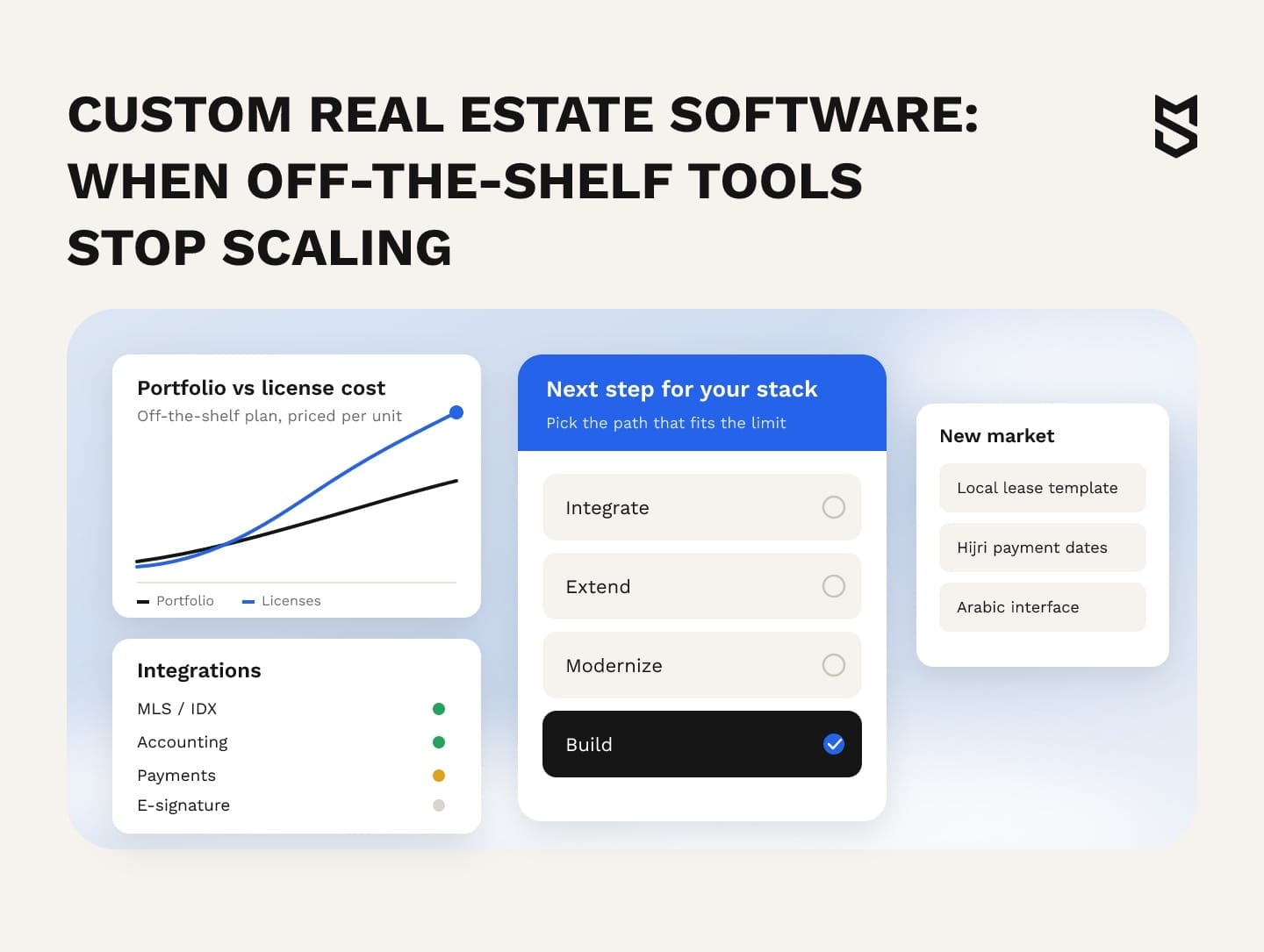
It may be time to look at custom real estate software when off-the-shelf license costs, scattered data or a missing integration start to hold back your next stage of growth. Here's how to read the signs and pick a route.
Highlights:
- Compare five-year license, workaround and transition costs before committing to any route.
- Name what fails to grow first: connections, one function, the core or the workflow.
- Check integration access and data quality before anyone estimates the screens.
Growing portfolios and brokerages know this scene well. The property management SaaS that ran your first buildings now has a spreadsheet next to it and an automation chain under it, and someone has to reconcile both at month-end.
Technology budgets across the sector are rising. Deloitte's 2027 Commercial Real Estate Outlook surveyed 950 executives at commercial real estate owners and investors with at least $250 million under management in June and July 2026.
More than 90% plan to increase data and technology spending next year, up from 76% a year earlier. The report names uneven data foundations and legacy processes among the barriers to putting AI into production.
This guide is for founders and owners deciding whether to integrate, extend, modernize or build. It covers the time, cost and risk of each route.
We've built real estate platforms for the US and MENA markets, including the AnyCurb marketplace and the Mulki property app. We've also moved a 40TB platform to AWS while it stayed live.
If you're weighing these options now, the first question is which of your current systems is holding back the next stage of growth.
Signs your off-the-shelf real estate software has hit its limit
Your packaged system needs a review when working around it costs more every year and that cost grows faster than the business. One sign is enough if it delays reporting, raises operating costs or blocks a planned market launch.
- License fees rise with every unit you add, because most packaged systems price per unit per month, often with a unit minimum and a minimum spend.
- The same tenant, lease or listing lives in three systems and a spreadsheet, and nobody is sure which copy is current.
- An integration you need (MLS/IDX feed, accounting, payments or e-signature) isn't available, or comes only as a paid add-on with limits.
- A new market needs a language, calendar, currency or lease rule the vendor doesn't support.
- Month-end and investor reports are put together by hand from exports.
- The system slows down or times out on peak days, such as rent collection at the start of the month or during leasing season.
When packaged software is still enough
Staying put is usually the better call if you operate in one market, your processes match the vendor's defaults and your data isn't an asset you analyze or sell. A packaged tool spreads its development cost across all its customers, and updates arrive without your team having to manage them.
The math changes once your process or data becomes the reason clients choose you.
Custom real estate software vs off-the-shelf: integrate, extend, modernize or build
Four routes are open, and the right one depends on which part of your setup has stopped keeping up: the connections between tools, one missing function, an aging core or a workflow that has become your product.
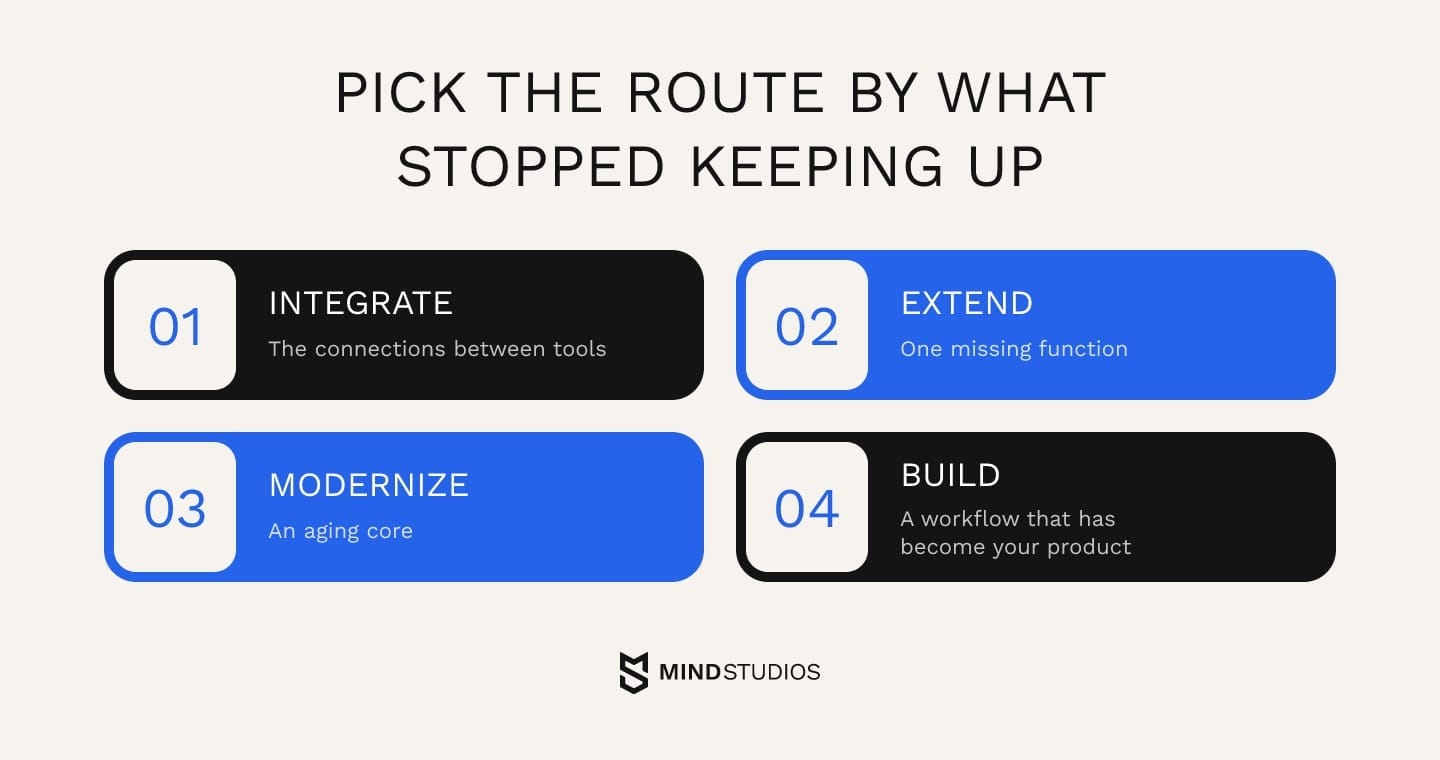
Here's how the four routes compare on fit and main risk:
| Route | When it fits | Main risk |
|---|---|---|
| Integrate existing systems via API | Tools work well alone but don't share data | Vendor API limits and version changes |
| Extend on top of SaaS | One missing function, such as custom billing or a client portal | Dependence on a platform you don't control |
| Modernize your own legacy system | Your system blocks releases or can't handle the load | Moving data without loss or downtime |
| Build your own platform | Workflow and data are your competitive asset | Higher upfront cost and full ownership duties |
Each route stalls on something different, and that drives its timeline. Integration depends on API access and record mapping, an extension on what the SaaS exposes through its API and terms. Modernization moves at the pace of untangling dependencies, while a new platform depends on how tightly you scope the first release.
An extension fits when the core platform still supports your operations: a billing layer with volume-based invoicing, for example, can produce enterprise invoices that the SaaS can't generate on its own.
A quick decision path
Choose the route by naming what fails to grow first: cost, data or process.
- Tools work and share data well enough → keep them for now.
- A specific data exchange between tools is missing → integrate.
- The vendor lacks one function → extend on top of it.
- Your own system blocks releases or can't meet operational needs → assess modernization.
- Your workflow and data are your product → build your own.
Which types of real estate software reach the ceiling
Each type hits its limit in a different place:
- A real estate CRM starts to strain when pipelines spread across several offices and lead sources.
- A listing platform strains when MLS feeds and search traffic grow together.
- Property management software strains when a portfolio mixes asset types or markets, and our guide to property management software covers that category in depth.
What does scale mean for a real estate business: three layers
Growth puts pressure on three layers: capacity, market requirements and product changes. They fail independently. A platform can take on more tenants without trouble while a new market exposes gaps in lease rules, so each layer needs its own fix.
Here's what breaks on each layer and how to fix it:
| Layer | What breaks | How to fix |
|---|---|---|
| Technical | Timeouts on rent day, slow listing search, manual restarts | Cloud hosting with elastic capacity, queues for payment spikes, caching for search |
| Market | Missing languages, calendars, currencies, lease rules and local payment methods | Localization in the data model, per-market configuration, local payment providers |
| Feature | Every release risks breaking old functions, so releases slow down | Modular architecture, multi-tenancy for franchises and white-label brands, automated tests |
The technical layer protects revenue on your busiest days, because a portal that fails during rent collection pushes payments into email and phone calls. The market layer sets how fast you can open a new market: if expansion is planned, put local calendars, currencies and lease rules in the data model before they reach live payment schedules.
The feature layer is the easiest to neglect. Without modular boundaries, every new module touches the whole codebase, so release cycles get longer just when the business needs them shorter.
Dmytro Dobrytskyi, CEO at Mind Studios, explains what he checks first when a real estate owner says the business is ready to grow:
Most owners describe growth as more units, more agents or a second city. Whether that growth pays off depends on how well operations and software absorb it without a new hire for every building. On Mulki, leases arrived on paper in one standard Saudi template, so we built ML scanning to capture the key data automatically. Start by finding where your people retype data.
Real estate software integrations and tech stack that decide whether you can scale
Integrations and data need an early feasibility check. Every external system brings its own data model, rate limits, licensing terms and failure modes, and your team controls none of them. That's why the integration map belongs in discovery, before anyone estimates the screens.
MLS data shows this best. The RESO Web API standard uses RESTful design and the OData V4 specification and can return data as JSON, and RESO has deprecated the older RETS protocol. RESO doesn't supply listing data itself, so you need separate credentials from each MLS, which you get after agreeing to its data use and licensing policies.
In practice, each new MLS is its own small project with its own approval timeline. Here's what to plan for each real estate software integration:
| Integration | Without it | API checks |
|---|---|---|
| MLS/IDX via RESO Web API | Stale listings, manual uploads, gaps in display rules | Licensing terms, Data Dictionary version, rate limits |
| Accounting (QuickBooks, Xero and similar) | Double entry, month-end reconciliation by hand | Sync direction, chart-of-accounts mapping, webhooks |
| Payments (Stripe, ACH, local methods) | Manual rent matching, missing payout options in some countries | Payout speed per country, fees, local methods |
| E-signature | Paper leases, lost versions, slow renewals | Template API, audit trail, per-envelope pricing |
| Maps and geodata | Weak area search, no radius filters | Geocoding quotas, cost per request, caching rules |
| Tenant verification | Fraud risk, manual credit checks | Data sources, consent flow, cost per check |
Tenant verification shapes the consent flow, so plan it early. One option is a solvency check through a bank API that returns a credibility score for each application.
Mind Studios' approach: For an MLS-based product such as AnyCurb, settle data licensing and display rules with each MLS before design starts, because those rules decide what your screens are allowed to show.
A real estate tech stack that grows with you
A real estate tech stack that supports geospatial search and scheduled imports usually includes:
- Backend: a mainstream framework with background jobs for imports and payments.
- Database: PostgreSQL with PostGIS for geospatial queries such as radius search.
- Cloud: AWS or an equivalent, with managed databases and object storage for documents.
- Queues and cache: for MLS imports, notifications and listing search.
- Access: SSO for staff and role-based permissions for owners, managers and tenants.
- Monitoring: error tracking and alerts when an integration fails.
If accounting and operations already run on an ERP, our guide to ERP integration covers the sync patterns.
Modernizing legacy real estate software without stopping operations
You can modernize or replace a legacy system while the business keeps running: old and new systems run in parallel for a period, data moves in layers with checks at each step, and the cutover has a rehearsed rollback. The old system is retired only after the new one has handled real traffic.
Most legacy real estate software holds years of lease history, deposits and payment records that legal and finance still rely on, so data migration checks have to cover balances and historical transactions:
- Audit the current system and data. Map every table, export and side spreadsheet, and mark the records that involve money: leases, balances, deposits.
- Run old and new in parallel. Name one source of truth for each record type, so both sides stay comparable.
- Migrate data in layers. Profile it, clean up duplicates and broken references, then do a dry run on a copy and reconcile totals before anything moves live.
- Cut over with a rollback path. Move users in groups, log every payment or lease edit in the new system so it can be replayed if you roll back, and keep the old environment ready to take traffic back.
- Retire the old system. Shut it down only after a full billing cycle shows matching numbers on both sides and a named owner on your side signs off.
On MyMP3Pool, a US DJ subscription platform whose 40TB library sat on one physical drive with no backup and 38TB already used, we ran both environments in parallel. New content went straight to cloud storage while the old server kept processing. The migration finished with zero downtime, and adding a CDN afterward cut delivery costs by 30%.
Mind Studios' insight: On MyMP3Pool, the old production environment stayed live for one month after cutover as a fallback. Budget for that overlap in hosting from day one.
Our modernization strategies guide compares the main approaches if you're still choosing between them.
Challenges of scaling a real estate business and how to solve them
When you scale a real estate business, four challenges need a plan: technical limits, budget pressure, compliance in new markets and competition. Addressing them during discovery helps the team find dependencies that could delay the first release.
Technical limits
Platforms built for their early users can fail under concurrency, when rent day, a listing import and a reporting job hit the same database at once.
- Do: move heavy jobs (imports, reports, notifications) into queues and run on managed cloud services with elastic capacity.
- Don't: buy a bigger server and hope the next peak looks like the last one.
Budget pressure
Phasing lets you scope each release against what the previous one taught you. Mulki's collaboration began in October 2021, the MVP launched in September 2022 and development continued until March 2024.
- Do: launch a first version around one workflow that already costs you money, then extend it.
- Don't: fund every module up front just because the roadmap looks complete on paper.
Compliance in new markets
Every market adds rules that belong in the architecture. In the US, the Fair Housing Act prohibits discrimination based on race, color, national origin, religion, sex, familial status or disability, which affects listing filters and screening criteria.
The CCPA applies to for-profit businesses that do business in California, collect consumers' personal information and meet at least one threshold, such as the revenue threshold of $26,625,000 in annual gross revenue, effective January 1, 2025.
In the EU, GDPR rights come with conditions. As the Irish regulator explains, erasure doesn't apply where you must keep data to meet a legal obligation, and data portability covers data a tenant provided, processed automatically under consent or a contract. Your data model has to flag which records can be exported, deleted or must be kept.
Saudi Arabia's Personal Data Protection Law came into effect on September 14, 2023, with SDAIA as the regulator. Storage and consent need a separate review for that market.
Mind Studios is ISO 27001 and ISO 9001 certified, as listed on our homepage, which helps when your compliance team asks how a development partner handles security and quality.
- Do: map privacy, fair housing and data residency rules for each market during discovery.
- Don't: localize the interface and leave storage and consent flows for later.
Competition
Companies on the same SaaS can differ through configuration, integrations and service until the service clients value depends on a workflow or data model the vendor can't support. AnyCurb, for example, built its product around a likely-to-sell score calculated from housing data.
- Do: treat lease, payment and listing history as an asset stored in a schema you control.
- Don't: leave your best data locked in a vendor's export format.
How custom real estate software development works step by step
The process runs in seven steps, from discovery to post-launch support. Each should give you a result you can check and a moment to ask your partner about ownership, risk and handover.
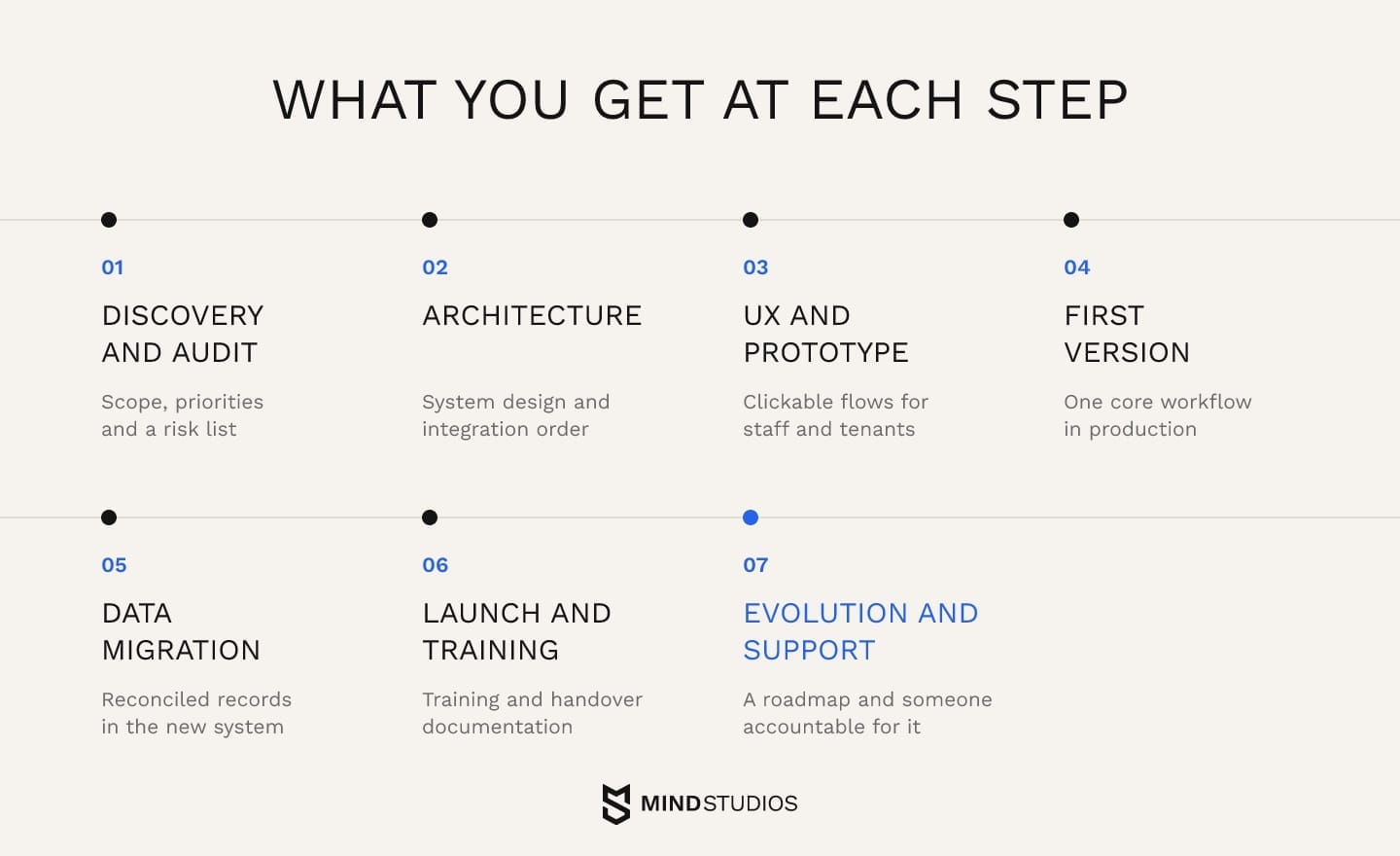
- Discovery and audit of current systems. You get a scope, priorities and a risk list. Ask: What do you need from our current vendor before you can estimate?
- Architecture and integration map. You get the system design and the order in which external systems are connected. Ask: Which integration is the riskiest, and how will you test it first?
- UX and prototype. You get clickable flows for staff and tenants. Ask: Will our property managers test the prototype before development starts?
- First version. You get one core workflow running in production. Ask: Who owns the code, repositories and cloud accounts from day one?
- Data migration. You get reconciled records in the new system. Ask: How will you prove nothing was lost?
- Launch and team training. Your team gets training and handover documentation, with adoption criteria agreed before launch. Ask: What documentation do we receive at handover?
- Evolution and support. You get a roadmap and someone accountable for it. Ask: What happens after launch if something breaks at night?
A partner offering custom software development for real estate industry clients should be able to show what it delivered at each of these steps.
Real estate management software development adds one check at step two: permissions for owners, managers, tenants and contractors have to be designed together, because each role sees different money and documents. Projects can run on fixed price, time and materials or a dedicated team, and the right model depends on how settled your scope is.
Anton Baryshevskyi, Head of Business Development and Co-Founder at Mind Studios, describes how first conversations about replacing a packaged system usually go:
Founders usually open with a feature list for the new platform. We ask for their exports, the side spreadsheets and the reports someone builds by hand every month, because those show what the new system has to own. The better a partner already knows your data, the shorter that stage gets. On MyMP3Pool, we'd worked with the system since 2013, so the migration needed no separate discovery phase.
If you're about to replace a packaged system, the exports and side spreadsheets your team relies on today are where the scoping conversation should start.
Cost drivers and total cost of ownership: what a custom platform really costs
Six drivers set the cost of a custom platform: integrations, migration, markets and languages, mobile clients, compliance and load. A fair estimate states its assumptions for each one, so you can compare it with the packaged tool at the same rate of portfolio growth.
Here's how each driver moves the budget and how to contain it:
| Cost driver | Cost impact | How to reduce |
|---|---|---|
| Number of integrations | Each brings its own data model, testing and licensing | Start with the ones that touch money or listings |
| Migration volume and quality | Messy records multiply cleaning and reconciliation work | Profile and clean data before the build starts |
| Markets and languages | Calendars, currencies, RTL layouts and legal rules per market | Put localization in the data model from release one |
| Mobile clients | Separate apps add design, QA and store releases | Start with web for staff, add apps for tenants later |
| Compliance | Audit trails, consent flows, data residency | Map the rules per market during discovery |
| Load | Rent-day and leasing-season peaks drive infrastructure | Queues, caching and elastic cloud capacity |
Most property management software ties its price to unit count, so a 2,000-unit portfolio pays for every unit every month before add-ons, usually with a minimum spend as a floor. Add the staff hours spent on workarounds, and remember that the license line grows with every acquisition.
The custom side has its own line items:
- initial build and data migration
- a period of running both systems in parallel
- hosting, monitoring and security work
- support and change requests
- an internal product owner who sets priorities
Run both columns over five years against your acquisition plan, with transition costs included.
Myth: Custom real estate platforms always cost more than a subscription.
Fact: A custom platform needs more cash before launch, while a subscription spreads its cost over time. Over several years, unit growth, paid add-ons, manual work and transition costs decide which total ends up lower.

What we've built for real estate: Mulki and AnyCurb
Two projects show what software development for real estate looks like on the build route. AnyCurb turned MLS data into a product of its own, and Mulki is a proptech software development project shaped by the lease rules of a new market.
AnyCurb: MLS data turned into a prediction
Our collaboration with AnyCurb ran from April 2019 to October 2020. The platform connects to MLS listings with real-time property updates and automates data collection to find potential sellers and off-market properties. Its likely-to-sell algorithm analyzes 300+ metrics per home and reached 85% prediction accuracy, verified by a third party.
Coverage started in Illinois and Kentucky, and the platform can now process data from any state for a data origination fee. If you plan to expand, budget for data access in each new market alongside the engineering.
Mulki: a property platform built around Saudi lease rules
Ibrahim Said, a founder from Jeddah, needed a property management app for Saudi landlords. Between October 2021 and March 2024, we built ML scanning of paper leases, payment calendars generated from each lease and Hijri due dates. All of it runs in an Arabic interface where numbers read left to right.
Here's what each case, including the migration project, suggests for your decision:
| Case | Route it illustrates | What it shows |
|---|---|---|
| AnyCurb (US) | Build: data as the product | Build when clients choose you for your data model |
| Mulki (MENA) | Build for a new market, released in phases | Launch a first release while developing later modules |
| MyMP3Pool on AWS (US) | Modernize in parallel with a rollback path | A live platform can change its core without downtime |
Use the same lens on your own setup before you pick a route.
Conclusion
Go back to the spreadsheet next to your property management system. If it's there because one integration is missing, connect or extend what you already have. If your own system can't keep up, modernize it in parallel with a rollback path. If your process and data are what clients pay for, that's your case for building.
The right route is the one that removes the workaround at its source.
If an aging core system is the bottleneck, our software modernization team handles the parallel-run approach described above.
When you're ready to test the decision against your own setup, the next step is an audit of your current systems and a discovery plan for the route you choose.
FAQ
When does a real estate business need custom real estate software instead of off-the-shelf tools?
It's worth looking into when working around the tool costs more every year. Typical signals are per-unit fees growing faster than revenue, data copied across tools, a missing MLS, accounting or payment integration, or an unsupported market. In one market with standard processes, a packaged tool is usually still the better choice.
How much does it cost to build custom software for a real estate company?
These factors set the budget, and an early estimate should state its assumptions for each:
- number and quality of integrations
- volume and condition of the data to move
- markets, languages and compliance rules
- web only, or web plus mobile apps
- expected peak load
Compare the result with five years of licenses and workarounds.
How long does custom real estate software development take?
The timeline depends on integration access, data quality and the scope of the first release. For reference, Mulki's collaboration started in October 2021 and its MVP launched in September 2022. Discovery and an early integration map shorten the schedule because they surface blockers before coding starts.
Can we keep our current property management software and scale a real estate business around it?
Often, yes. If the core works and one function is missing, connect it to your other tools through its API or build a layer on top, such as a client portal or custom billing. The vendor's API limits and terms set how far that extension can go.
How do you migrate data from a legacy system without downtime?
Run both systems in parallel with one source of truth at each stage, move data in layers with reconciliation, and rehearse a logged rollback before cutover. For MyMP3Pool, we ran the environments in parallel and completed the migration with zero downtime. If continuous sync isn't feasible, plan an agreed downtime window.
Which real estate software integrations matter most: MLS/IDX, accounting, payments or e-signature?
Start with the integrations that touch money or listings:
- MLS/IDX through the RESO Web API, if you display listings
- accounting sync, to end manual reconciliation
- payments with local methods in each market
- e-signature, to close the lease workflow
For each one, check rate limits, versioning and per-request pricing.
How do you adapt real estate software for a new market such as Saudi Arabia or the EU?
Build localization into the data model: languages, right-to-left layouts, local calendars, currencies and lease rules. Mulki, for example, needed Hijri payment schedules and an Arabic interface with left-to-right numbers. Map privacy rules early, such as GDPR retention and erasure conditions in the EU and the PDPL in Saudi Arabia.
What software do real estate developers and property companies use, and when do they outgrow it?
Most run a mix of:
- a CRM for leads and deals
- property management software for leases, rent and maintenance
- listing tools fed by MLS data
- accounting and project management systems
They outgrow that mix when portfolios span markets or asset types, or when their data becomes a product in its own right.